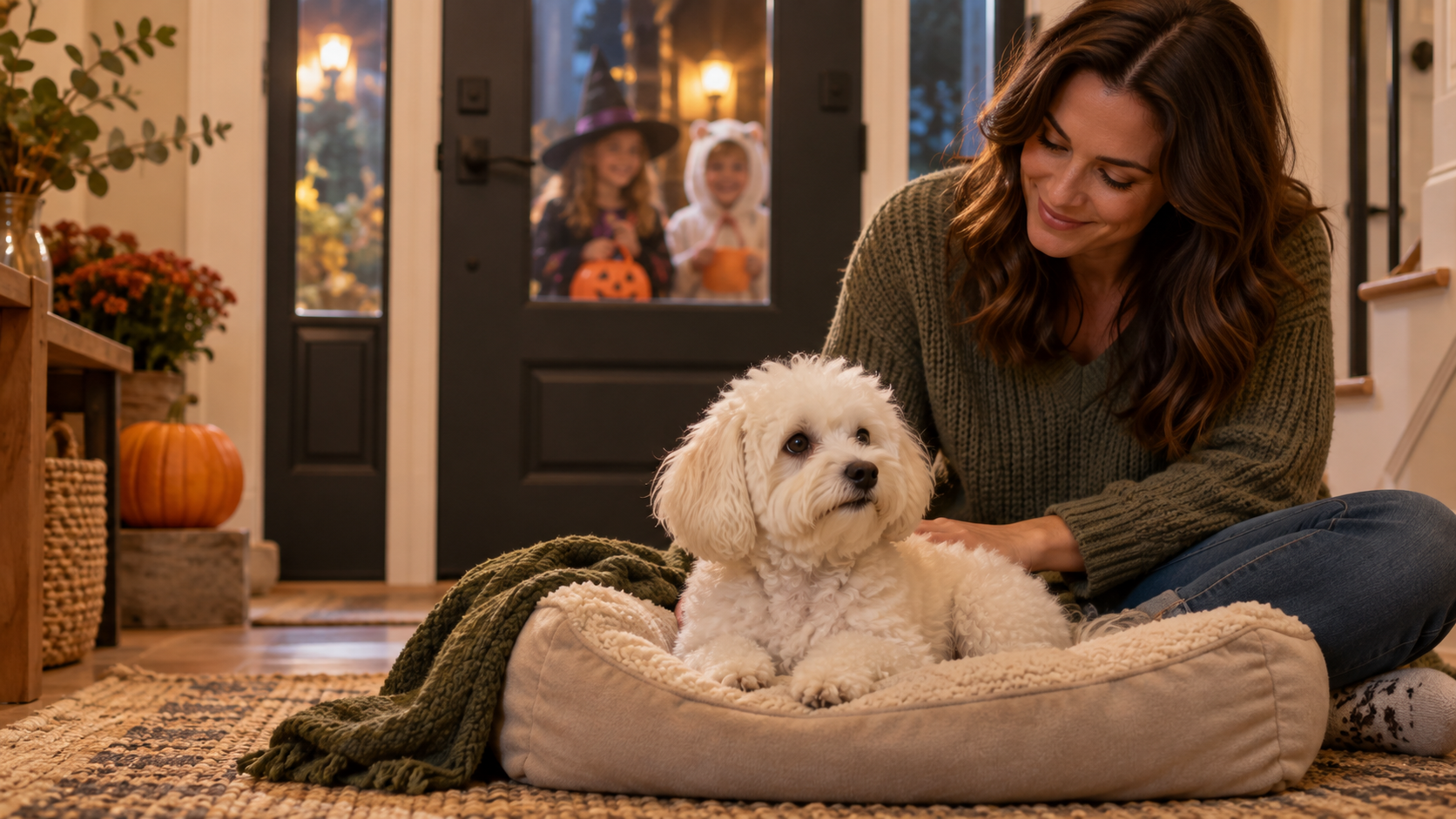
How to Keep Your Dog Calm on Halloween: Doorbells, Costumes, and Trick-or-Treaters
Affiliate disclosure: This post contains affiliate links. If you make a purchase through one of these links, I may earn a commission at no extra cost to you. You can read my full Affiliate Disclosure.
The doorbell rings for the first time, and your dog runs to the door and starts barking. Before you can calm them down, it rings again. On the other side of the door are children wearing masks, laughing loudly, and holding out bags of candy. Your dog no longer knows whether they should guard the house, greet the visitors, or run away from the strange person with no visible face.
To you, it is Halloween. To your dog, it is an evening when their familiar home suddenly fills with strange sounds, unfamiliar smells, and people who do not look like people.
If you are wondering how to keep your dog calm on Halloween, the answer starts before the first visitor arrives. A little preparation can prevent nonstop barking, panic, and a dangerous dash through an open door.
Quick Answer: How Do You Keep Your Dog Calm on Halloween?
The best solution is not to keep your dog beside the front door and expect them to get used to the noise while the doorbell rings over and over again. Set up a quiet, safe space away from the entrance before the first trick-or-treaters arrive. Take your dog for a walk earlier in the day, close the windows and blinds if they react to people outside, and lower the volume of the doorbell or turn it off for the evening if you can.
If your dog loves visitors and handles noise well, they may be able to spend part of the evening with you, but only under supervision and away from the open door. If your dog barks, trembles, pants, tries to hide, or rushes toward the exit, a quiet room is not a punishment. It is the safest place for them.
Is Your Dog’s Reaction Normal or a Reason to Worry?
A little nervousness on such an unusual evening is not surprising. However, not every reaction is the same.
| Your dog can probably settle with your help | Your dog needs more support and caution |
|---|---|
| Barks briefly when the doorbell rings | Cannot stop barking even after moving away from the door |
| Watches a costume curiously from a distance | Tries to escape, hide, or push through the door |
| Takes a treat and can turn their attention back to you | Refuses a favorite treat and does not respond to you |
| Lies down or returns to a toy after a few minutes | Trembles, pants heavily, drools, or paces in panic |
| Wants to stay a little closer to you than usual | Growls, lunges, or tries to bite |
If you already know that your dog has a serious fear of noises, unfamiliar people, or children, do not wait until October 31 to see what happens. Talk to your veterinarian or a qualified dog behavior professional ahead of time. A sudden or unusually intense change in behavior also deserves professional attention.
Your Step by Step Plan for a Calmer Halloween
1. Practice the Doorbell Without Real Visitors
The doorbell is often the first trigger. Your dog hears the sound, runs to the door, barks, and then the door opens and a stranger appears. If that sequence happens ten or twenty times in one evening, the excitement and stress keep building.
Practice when nothing else is happening:
- Play a very quiet recording of a doorbell, or ask someone in your home to ring the real bell once.
- Immediately toss a few small treats away from the front door, or send your dog to their mat.
- End the practice session while your dog is still calm.
- The next time, gradually increase the volume or add a soft knock.
The goal is not to make your dog love the doorbell overnight. You are helping them learn a new pattern: I hear the doorbell, I move away from the door, and something good is waiting for me there.
If even a quiet sound makes your dog so nervous that they cannot take a treat, the exercise is too difficult. Lower the volume or increase the distance. Do not ring the bell repeatedly in the hope that your dog will simply get used to it. Overwhelming a frightened dog can make the problem worse.
If your dog reacts to every sound in the hallway, you may also find this guide helpful: How to Stop Excessive Dog Barking Without Yelling or Punishment.
2. Set Up a Safe Room Before the Evening Begins
Choose a room as far away from the front door as possible. Put the following items inside:
- A bed or blanket your dog already uses
- Fresh water
- A safe chew toy, a stuffed toy, or a lick mat
- Soft music, a fan, the television, or white noise to soften the sound of the doorbell and voices in the hallway
- A favorite toy and a few treats
A closed door or a baby gate should prevent your dog from rushing outside when the front door opens. Check that your dog is wearing an identification tag and that the contact details linked to their microchip are current. Even a dog who does not normally try to escape may panic when faced with a group of noisy children in masks.
One important note: if your dog does not already feel comfortable in a closed crate or carrier, Halloween is not the time to shut them inside one for several hours. Choose a space where they already feel safe.
3. Walk Your Dog Before the Crowds Arrive
A longer walk with plenty of time to sniff and go potty before the streets fill with people in costumes can make the evening much easier. Finish the walk early enough that you are not heading home just as groups of children begin gathering outside.
A tired dog is not automatically a calm dog, especially when they are frightened. Still, a dog who has had a chance to move, sniff, and go potty will find it easier to rest than a dog who has been waiting for a walk all day.
If the weather is bad or you need a quiet activity indoors, try one of these Indoor Enrichment Games for Small Dogs on Rainy Days. Choose sniffing games, licking activities, and simple puzzles instead of wild play that could make your dog even more excited a few minutes before the first doorbell rings.
4. Prevent Your Dog From Rushing the Door
The most dangerous part of the evening is not always the noise or the costumes. Sometimes, it is the open front door.
You can:
- Place a bowl of candy or a small table outside if that is safe and common in your neighborhood
- Ask one person to hand out candy while another stays with the dog
- Put up a note asking visitors not to ring the doorbell and to knock softly or send a message instead
- Use a baby gate, a closed interior door, or two physical barriers between your dog and the exit
- Keep your dog on a leash only if they are calm and directly supervised, since a leash is not a reason to expose them to something frightening
Do not allow a child in costume to reach toward a nervous dog. Even a very social dog may react differently to a large hood, a mask, a stick, a glowing toy, or a sudden scream.
5. Introduce Costumes Gradually
Your dog recognizes you by your face, movement, voice, and scent. When you put on a large hat, a mask, or a long cape, your shape and the way you move can suddenly look completely different.
If you plan to wear a costume:
- Show your dog one part of the costume while you hold it in your hand.
- Place it on the floor and let your dog look at it from whatever distance they choose.
- Reward calm observation without using food to lure your dog directly toward the item.
- Put on only one part of the costume, speak in your normal voice, and turn slightly to the side instead of walking straight toward your dog.
- Add the next part only when your dog is relaxed.
If your dog moves away, lowers their body, turns their head, licks their lips, yawns, freezes, or refuses a treat, take a step back. Do not walk toward them laughing and saying, “It is only me.” Your dog may recognize your voice and still feel uncomfortable with what they see.
6. Should Your Dog Wear a Costume?
Only if your dog is genuinely comfortable wearing clothes.
A costume should not restrict your dog’s vision, hearing, breathing, barking, walking, eating, drinking, or ability to go potty. Check for tight elastic, small pieces your dog could swallow, loose straps that could get caught, and fabric that may cause your dog to overheat.
Try the costume at home for only a few seconds at first. Reward your dog, then take it off. If your dog freezes, tries to remove it, hides, walks strangely, or looks miserable, the photo is not worth their discomfort. A festive bandana or collar decoration is often enough, and some dogs are happiest wearing nothing at all.
Never leave a dog unattended while they are wearing a costume.
7. Give Your Dog a Calming Activity, but Keep It Safe
Sniffing, licking, and chewing can help your dog focus on a familiar activity. Offer something they already know how to use, such as a stuffed rubber toy, a lick mat, or a safe chew that is the right size for them.
If you have a young dog who already becomes overly playful in the evening, this plan for How to Calm a Puppy During the Evening Witching Hour may also help.
Do not give your dog a new bone, toy, or treat for the first time on Halloween and then close the door. Anything that could break, become stuck, or be swallowed requires supervision. If your dog is too nervous to eat, do not force them. It is a sign that they need more distance from the noise and fewer demands.
8. Calming Chews Can Be an Extra Tool, but They Are Not the Main Plan
If your dog already uses calming chews that work well for them, you can include them in the routine you prepare ahead of time. For example, Innovet Advanced Calming Chews may be one option for owners who want extra support alongside a quiet room, sound control, and careful planning.
This is an affiliate link. I may earn a commission if you make a purchase, at no extra cost to you.
However, no calming chew can make up for an open door, a constantly ringing doorbell, or forcing a frightened dog to meet visitors. Results can vary from one dog to another. Check the ingredients and follow the manufacturer’s directions. Talk to your veterinarian before use if your dog takes medication, has a health condition, is very young or old, or is pregnant or nursing.
What About Candy, Chocolate, and Decorations?
Do not leave bags of candy on the floor, on a low table, or in a child’s room that your dog can enter. Chocolate can be toxic to dogs, and sugar free products may contain xylitol, which is especially dangerous. Raisins, candy wrappers, and lollipop sticks can also cause serious problems.
If you think your dog ate chocolate, candy containing xylitol, or another dangerous product, call your veterinarian or the nearest emergency veterinary clinic immediately. Do not wait for symptoms to appear, and do not try to make your dog vomit unless a veterinary professional tells you to do so. Keep the packaging and tell the veterinarian approximately how much your dog ate, when it happened, and how much your dog weighs.
Keep candles and lit pumpkins away from wagging tails, curious noses, and paws. Move electrical cords away from dogs who like to chew, and do not leave decorations with small pieces, string, or artificial spiderwebs where your dog could swallow them or become tangled.
What I Have Learned From Working With Dogs
After more than 15 years of living and working with dogs, I have learned that owners often overestimate how much a dog can handle when there is a lot of excitement in the house. Your dog may know the sound of the doorbell. They may be familiar with children. They have probably seen hoods and hats before. But when all of those things happen at once, including the doorbell, screaming, an open door, masks, the smell of food, and a nervous owner, it becomes a completely new situation.
That is why I do not wait for a dog to show me that they have had too much. I would rather reduce the number of things they need to handle ahead of time.
A quiet room, a familiar routine, and a physical barrier in front of the exit are not an overreaction. They are a good plan. Your dog does not have to take part in every family celebration to be loved and included.
If you want to learn how to recognize when your dog truly feels safe with you, look for these Signs Your Dog Trusts You.
Common Mistakes Dog Owners Make
Waiting for the First Ring Before Looking for a Solution
Once your dog has crossed their threshold for excitement or fear, getting their attention becomes much harder. The room, toys, water, and background noise should be ready before the first visitor arrives.
Opening the Door While the Dog Is Standing Right Behind It
One unexpected movement from a child or a sudden noise from a decoration may be enough to send your dog running outside. One closed door or baby gate can make an enormous difference.
Punishing the Barking
Yelling adds even more noise and may convince your dog that something dangerous really is happening. Move them away from the trigger, make the situation less intense, and reward the behavior you want to see.
Forcing the Dog to “See That the Mask Is Not Scary”
Forcing your dog to move closer does not build confidence. Let them keep their distance and decide whether they want to approach.
Giving a Calming Supplement and Ignoring Everything Else
A supplement can only be one part of the plan. The environment, distance from triggers, escape prevention, and realistic expectations are still more important.
Dressing the Dog for a Photo and Ignoring Their Body Language
A dog who freezes is not necessarily calm. They may have simply stopped trying to escape an uncomfortable situation.
Your October 31 Checklist
Save this list and check it before the first visitors arrive:
- Your dog has had a walk and a chance to go potty before the crowds arrive.
- Your dog is wearing an identification tag, and their microchip details are current.
- The quiet room is ready with water, a bed, and a familiar activity.
- The windows and blinds are arranged so your dog cannot watch every person passing outside.
- Music, the television, a fan, or white noise helps soften sounds from the entrance.
- There is at least one physical barrier, and preferably two, between your dog and the front door.
- Candy, chocolate, xylitol, and wrappers are out of reach.
- Candles, electrical cords, and small decorations are secure.
- Your dog’s costume has been tested, or you have decided they will not wear one.
- You have the phone numbers for your veterinarian and the nearest emergency clinic ready.
Frequently Asked Questions
The doorbell predicts unfamiliar people and an opening door, so it can trigger excitement, alert behavior, or fear. On Halloween, that pattern repeats much more often than usual, which can make your dog more tense as the evening continues.
Only if your dog has already shown that they can remain calm around children, costumes, and doors that open frequently. Even then, they need close supervision and physical control. For most dogs, staying away from the entrance is safer.
You do not need to withhold calm comfort. You can sit beside your dog, speak in a normal voice, or let them move to a safe place. The important thing is not to pull them toward whatever frightens them or add more panic with your own behavior.
It depends on the product, its ingredients, and the individual dog. Read the directions before the holiday, and do not try a new product for the first time during the loudest part of the evening. If your dog has an intense fear response, ask your veterinarian for advice instead of relying only on a supplement.
It often means the situation is too difficult for them. Move farther away from the door, reduce the noise, and let your dog retreat to a safer place.
Use a closed room, a baby gate, or two barriers between your dog and the exit. A collar with an identification tag and current microchip details provides extra protection, but it does not replace a physical barrier.
A Calm Halloween Does Not Mean Your Dog Feels Nothing
The goal is not to make your dog sit beside the door for hours without reacting while doorbells ring, children shout, and people in masks walk past. The goal is to help your dog feel safe enough and prevent situations that could become dangerous.
Prepare the space, reduce the number of triggers, and give your dog permission to move away. If they are happiest in another room with familiar sounds and a favorite toy, they have not missed the fun. They have received exactly what they needed.