Are Automatic Dog Doors Safe? Pros, Cons and What to Know Before Buying
Note: Some links in this article are affiliate links, which means I may earn a small commission if you choose to purchase through them. This comes at no extra cost to you. I only recommend products I truly believe in and would confidently give to my own dog.
Automatic dog doors sound like one of those solutions that can make everyday life so much easier. Your dog no longer has to stand by the door, stare at you meaningfully, and wait for you to figure out what they want. You do not have to stop working, eating lunch, or sleeping every time your dog wants to go into the yard, only for them to change their mind the moment you open the door.
But it is completely normal to wonder before buying one: Are automatic dog doors really safe?
The short answer is: A good automatic dog door can be safer than a regular pet door, but only if you choose the right model, install it properly, and do not use it as a substitute for a secure yard and responsible supervision.
Not all automatic dog doors are the same. Some simply unlock when they recognize a tag on your dog’s collar, while more advanced models have a solid panel that automatically moves up and down. They also differ in their locking systems, sensors, power sources, weather protection, and entry and exit controls.
That is why it is not enough to choose the model that looks best in a photo. Let us look at what automatic dog doors can really offer, where potential problems may arise, and what you should check before cutting a hole in a door or wall of your home.
How Do Automatic Dog Doors Work?
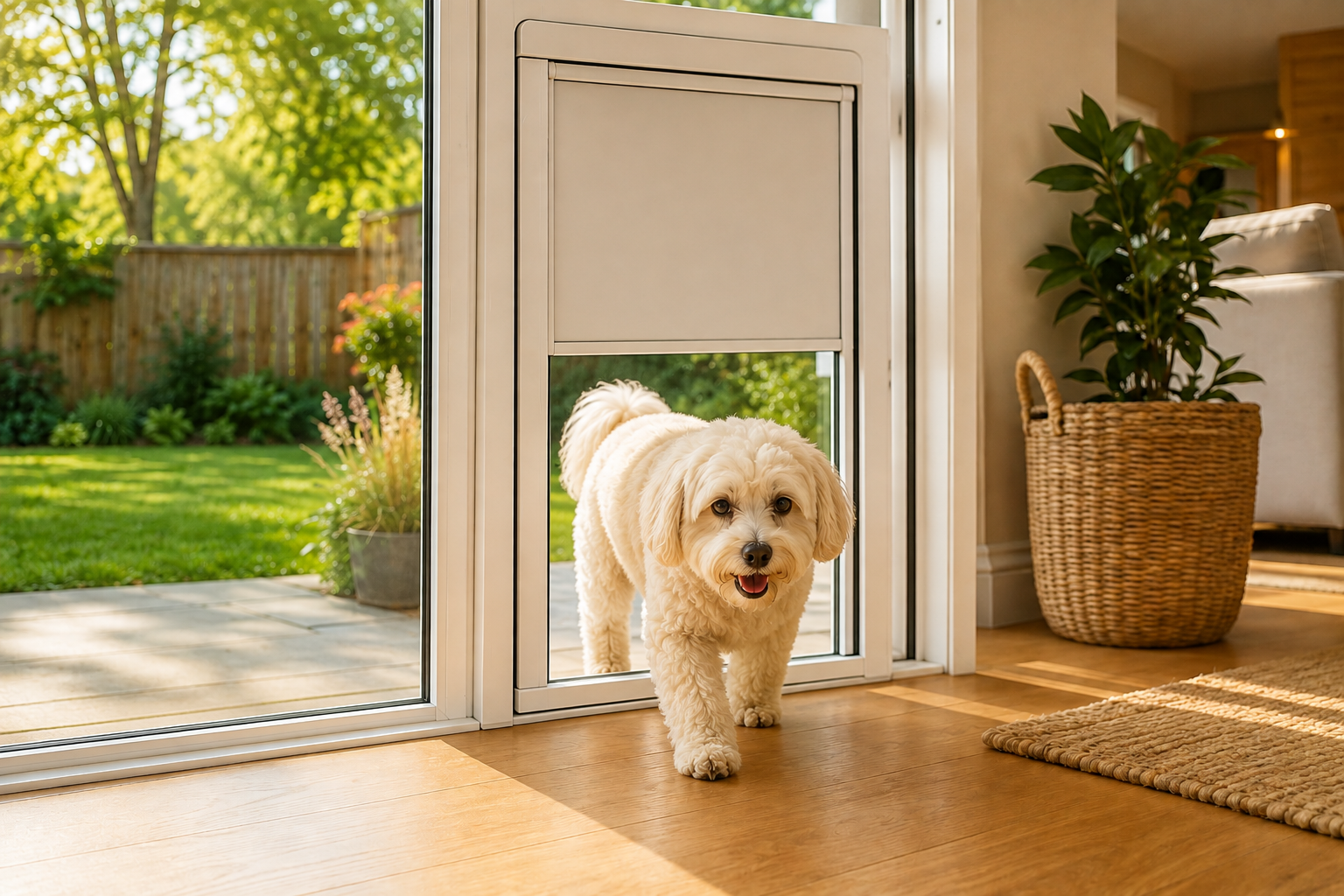
Most electronic pet doors work with a special sensor or electronic key attached to your dog’s collar. When your dog approaches the door, the system recognizes the signal and unlocks the flap or raises the panel. Once your dog passes through, the door closes and locks again.
Some models only detect that the dog is nearby. More advanced systems can also detect the direction your dog is moving, so the door does not open every time your dog simply walks past it, lies down nearby, or stops to sniff the corner.
Depending on the model, you may also be able to:
- decide when your dog is allowed to enter or leave;
- set different access rules for multiple pets;
- lock the door in one direction or both directions;
- control the door through an app;
- receive notifications when your dog uses it;
- use backup battery power during a power outage.
These features sound great, but they are more than interesting pieces of technology. The real value of an automatic dog door lies in how well it controls access and how reliably it works in everyday situations.
Are Automatic Dog Doors Safer Than Regular Dog Doors?
In many situations, yes.
A regular dog door with a flexible flap can often be pushed open by any animal small enough to fit through it. Depending on where you live, that could mean a neighbor’s cat, a raccoon, an opossum, or another unwanted nighttime visitor. A larger opening can also create an additional weak point in your home’s security.
Electronic dog doors only open when they recognize an approved sensor, electronic key, or microchip, depending on the model. They lock again after your dog passes through. This does not make them completely impossible to break into, but they provide much more controlled access than a traditional flap that is always available.
However, there is an important difference to understand: An electronic dog door may control who can pass through the opening, but it cannot make an unsafe yard safe.
If your dog can jump the fence, dig underneath it, reach a swimming pool, get into toxic plants or garden chemicals, or escape through a gate that is often left open, an automatic dog door will not solve that problem. The door gives your dog the freedom to go outside. It is still your responsibility to make sure the space on the other side is truly safe.
Benefits of Automatic Dog Doors
1. Your Dog Gets More Freedom and You Get Fewer Interruptions
The biggest benefit is obvious: Your dog can go outside when they need to use the bathroom, stretch their legs, or spend a little time in the yard.
This can be especially helpful if you work from home, have an irregular schedule, live with an older dog who needs more frequent bathroom breaks, or have a young dog whose routine you are still carefully managing.
That does not mean you will never open the door for your dog again. You probably will, especially when it is raining and your dog is standing under the covered porch expecting their personal doorman. But your daily routine can become much easier.
2. Better Access Control Than a Regular Flap
A good electronic dog door does not remain open to every animal that approaches your home. It is activated only by the correct electronic key or another approved identification system.
This is one of the most important benefits for owners who like the convenience of a dog door but worry that wildlife or neighborhood animals could enter through a traditional flap.
3. The Ability to Set Access Times
Smart dog doors often allow you to choose when your dog can use them. For example, you may allow your dog to go outside during the day but automatically prevent access at night.
This can be useful if wildlife is active in your area after dark, if you do not want your dog going out early in the morning and waking the neighbors by barking, or if you prefer to keep your dog inside when no one is home.
4. They Can Be Useful in Homes With Multiple Pets
Models that support multiple sensors may allow you to decide which pet can go outside and which one must stay indoors.
This can make a big difference if, for example, you have an adult dog who can safely use the yard and a puppy who is not ready to go outside unsupervised. The same applies if one dog has a health problem, is recovering from a procedure, or simply has a talent for finding a problem in five minutes that other dogs would not find in five years.
5. A More Secure Seal and Better Weather Protection
Traditional soft flaps can let in cold air, heat, wind, and moisture. A solid panel and good weather seals may close the opening more securely.
However, you should not assume that every electronic model is automatically well insulated. If you live in an area with very cold winters, strong winds, or intense summer heat, check the specific weather sealing and insulation details for the model you are considering.
6. They Can Be a Major Help for Older Owners and People With Limited Mobility
For someone who has difficulty standing up, using stairs, or moving quickly, constantly opening the door for a dog is not a small inconvenience. In that situation, an automatic dog door is not just a luxury gadget. It can be a practical aid that helps the dog keep a regular routine while giving the owner more independence.
Drawbacks and Risks to Consider
1. Your Dog Goes Outside Without You
Freedom is a benefit only when the area on the other side of the door is safe. A dog who goes outside alone could eat something from the yard, dig an escape route, bark at people passing by, come into contact with wildlife, or stay outside during extreme heat or cold.
For this reason, an automatic dog door is not a good choice for a yard that is not fully fenced or for a dog you cannot yet trust outside without supervision.
2. No Electronic System Is Completely Free From Possible Problems
The sensor battery can run out. The power can go out. Your dog may lose the tag from their collar. The door may need cleaning, adjustment, or repairs.
Before buying, find out what happens during a power outage. Does the door remain locked? Does it have a backup battery? Is there a manual way to open or lock it? These details are far more important than a clever feature you may use twice just out of curiosity.
3. Some Dogs Are Afraid of the Sound and Movement
Your dog may not immediately understand that the moving panel is not a monster built into the wall. The sound of the motor, the panel rising, or the feeling of walking through a narrow opening can frighten a cautious dog.
Do not push your dog through the opening or expect them to learn everything in one day. Introduce the door gradually, use treats, and give your dog enough time to approach and explore it at their own pace.
4. The Wrong Size Can Be Uncomfortable or Unsafe
You should not choose a dog door based on weight alone. Two dogs of the same weight can have completely different heights, chest widths, and body shapes.
The opening should be wide enough for your dog to walk through without turning their body and high enough that they do not have to crouch unnaturally. The bottom edge should not be so high that a small, senior, or short-legged dog has to jump over it.
Measure the widest part of your dog’s body, their height at the shoulders, and the distance from the floor to the bottom of their chest. Then follow the manufacturer’s exact measuring instructions. Do not choose the smallest possible size simply because it costs less. It is no longer a bargain if your dog refuses to use the door or gets hurt while passing through it.
5. Installation Can Be Difficult and Permanent
Cutting into an exterior door or wall is not the kind of project where you want to use the “somewhere around here” method. A poorly placed opening can weaken the door, damage wiring or pipes inside a wall, allow water to enter, or prevent the product from fitting and sealing properly.
If you do not have experience with this type of work, include professional installation in your budget. Extra care is needed with metal doors, glass, thick walls, and any area that may contain electrical wiring or plumbing.
6. Good Automatic Dog Doors Are Not Cheap
An electronic sensor, motor, safety mechanism, solid panel, and programmable access controls cost more than a simple plastic flap. You may also need to pay for extra sensors, batteries, a wall installation tunnel, a power adapter, or professional installation.
Still, the cheapest model is not necessarily the best value. When a product requires you to cut an opening in an exterior wall or door, reliability, secure locking, replacement parts, and customer support matter more than saving a little money at the beginning.
Which Safety Features Should You Look For?
Before buying, check for the following features:
Selective Access
The door should respond only to a registered sensor, electronic key, or microchip, rather than opening in response to any nearby movement.
Directional Sensing
If the door can tell the difference between a dog approaching it directly and a dog simply walking past, it is less likely to open unnecessarily.
A Reliable Locking System
Check whether the panel locks automatically after your dog passes through and whether you can manually block entry, exit, or both.
Safety While Closing
For motorized models, look for a system that will not lower the panel while your dog is still in the opening. The door should remain open long enough for a slower, older, or uncertain dog to pass through without rushing.
Backup Power and Low Battery Alerts
It is helpful if the system has a backup battery or at least provides a clear warning when the battery is running low. You should also check what position the door remains in if it loses power.
Controls for Multiple Pets
If you have several dogs or both a cat and a dog, check how many sensors the system supports and whether you can set different access rules for each pet.
Weather Resistance
Pay attention to the seals, the electronics’ resistance to moisture, and the material used for the panel. If your dog wears a sensor on their collar, check whether it is waterproof or only water resistant. Those terms do not always mean the same thing.
Warranty, Replacement Parts, and Customer Support
The door may be used several times a day for years. Before buying, check whether replacement sensors, batteries, seals, and other parts are readily available. A good warranty means little if you cannot get help when you need it.
Do Automatic Dog Doors Protect Your Home From Burglars?
A small electronic door that locks after use generally creates less risk than a large flap that is always accessible. However, no pet door should be treated as your home’s main security system.
The risk depends on the size of the opening, where the door is installed, how strong the panel is, and how close it is to the lock on your main door. A large opening installed near a door handle could still create a security problem, even if an adult could not easily climb through it.
The safest location is often a wall or door leading to a fully fenced, private yard, away from the main lock and out of direct view from the street. When you travel or know the pet door will not be used for a while, it is helpful to have an additional manual locking option.
Are Automatic Dog Doors Right for Every Dog?
Not necessarily.
They can be a great choice for a calm adult dog who is fully house trained, stays reliably inside a fenced yard, and does not try to escape every time something interesting happens nearby.
They may not be a good choice for:
- a very young puppy who still needs constant supervision;
- a dog who jumps over or digs under fences;
- a dog with a strong prey drive when small animals enter the yard;
- a dog who barks excessively at neighbors and people passing by;
- a very fearful dog who struggles with moving objects and unfamiliar sounds;
- a dog who should not be outside unsupervised because of a health condition;
- a home without a fully secure and fenced outdoor space.
An automatic door should fit your dog and their habits. You should not expect every dog to adapt to the door simply because you paid a lot of money for it.
How to Teach Your Dog to Use an Automatic Dog Door
If the model allows it, turn off the automatic movement at first and let your dog explore the opening while the panel is raised or secured in place. Stand on the other side, call your dog in a cheerful voice, and reward every calm approach.
Next, introduce the sound and movement of the door from a greater distance. Reward your dog for staying relaxed. Only practice walking through while the system is operating once your dog can approach without fear.
The training process may look like this:
- Reward your dog for looking at and sniffing the door.
- Encourage them to walk through the fully open doorway.
- Repeat the exercise in both directions.
- Introduce the sound of the door opening without asking your dog to walk through immediately.
- Practice automatic opening while you are standing beside your dog.
- Gradually move farther away, but continue supervising at first.
Some dogs understand the idea after a few attempts. Others need several days or weeks. Speed does not matter. What matters is that your dog feels safe and walks through calmly, rather than going through only because someone is pushing them from behind.
What to Know Before Buying
Before ordering an automatic dog door, ask yourself these questions:
- Is my yard truly safe for my dog without supervision?
- Do I want a motorized panel that rises automatically or a flap that simply unlocks electronically?
- Can I restrict outdoor access at night or when no one is home?
- What happens if the power goes out or the battery dies?
- Does the system prevent the panel from closing while my dog is in the opening?
- Is the collar sensor small and comfortable enough for my dog?
- Does the door fit my dog’s body shape, rather than just their weight?
- Is the model designed for installation in my type of door or wall?
- How well does it seal the opening during winter and summer?
- Are replacement parts and additional sensors available?
- What will the total cost be after installation and accessories?
If a product does not provide clear answers to these questions, that may already be the answer you need.
When Does It Make Sense to Pay More?
A more expensive model can be worth it when you are paying for features you will use every day, rather than just an app and an attractive design. Useful features may include selective access, reliable locking, directional sensing, safe automatic closing, separate entry and exit settings, and backup power.
For example, Power Pet automatic dog doors from High Tech Pet use a sensor worn on your dog’s collar, while certain models offer motorized opening, four-way access control, and other features designed to give owners more control. If you are considering this type of door, compare the available sizes, power options, features of the specific model, and installation requirements before making your decision.
You are not simply buying an opening for your dog. You are buying a device that will open and close several times a day and become part of your home’s exterior security. Reliability is worth paying for here, as long as the door solves a real problem for you.
For example, Power Pet automatic dog doors from High Tech Pet use a sensor worn on your dog’s collar, while certain models offer motorized opening, four-way access control, and other features designed to give owners more control.
Final Verdict: Are Automatic Dog Doors Safe?
Yes, a good automatic dog door can be safe and extremely convenient when it is chosen carefully, installed correctly, and used responsibly. Compared with a traditional flap, it may offer better access control, automatic locking, and the ability to decide when and which pets are allowed outside.
However, the door itself cannot protect your dog from an unfenced yard, extreme temperatures, wildlife, or their own determination to escape. It provides freedom, but it does not replace a responsible owner.
If your dog can safely spend time in a secure yard and you would appreciate not having to get up ten times a day to let them out and back in, an automatic dog door could become one of those purchases that makes you wonder why you did not get one sooner.
If your yard is not completely secure or your dog is not ready to go outside alone, wait. The smartest purchase is not the one you make the fastest. It is the one that truly fits both your home and the dog who lives in it.
Frequently Asked Questions
Can Other Animals Enter Through an Automatic Dog Door?
Good automatic dog doors open only when they recognize a registered sensor, electronic key, or compatible microchip. This greatly reduces the chance of other animals entering, but the level of protection depends on the design and locking system of the specific model.
What Happens if the Power Goes Out?
It depends on the model. Some doors have a backup battery, some run entirely on batteries, and others leave the panel in a predetermined position. Always check this before buying.
Can a Dog Get Stuck in an Automatic Dog Door?
A well-designed motorized door should have a safety system that prevents it from closing while your dog is passing through. However, the door must still be the correct size, installed properly, and checked regularly.
Are Automatic Dog Doors Good for Small Dogs?
They can be, as long as the bottom edge is low enough, the opening suits the dog’s body shape, and the collar sensor is not too large or heavy. For a very small dog, the size of the sensor can be just as important as the size of the door.
Can a Dog Use an Automatic Door Without Training?
Some dogs accept one quickly, but every dog should be introduced gradually to the opening, sound, and movement of the panel. Forcing a dog through can create fear and make the entire process take longer.
Can Automatic Dog Doors Be Locked at Night?
Many models offer entry and exit controls or programmable schedules, but not all of them do. If nighttime locking is important to you, check whether the specific product provides that option without requiring you to physically block the opening.