
7 Healthy Human Foods for Dogs That May Support a Longer, Healthier Life
Can a few simple foods from your kitchen make a difference to your dog’s health?
Many dog owners believe that buying expensive dog food is enough to keep their pets healthy.
And sometimes, a good quality, complete and balanced dog food really does provide everything a healthy dog needs.
But what about those little extras?
A piece of carrot. A few blueberries. A spoonful of pumpkin.
Over more than 15 years of working with dogs, I’ve seen how different their eating habits can be. Some dogs will happily eat almost anything you offer. Others are surprisingly selective, even when you put something delicious in front of them.
I’ve also learned that what dogs enjoy eating and what their bodies actually need are not always the same thing.
The good news is that some everyday human foods can provide useful nutrients when offered in the right amounts.
But can they actually help your dog live longer?
No individual food has been proven to add years to a dog’s life. However, good nutrition, maintaining a healthy weight, regular exercise, and preventive veterinary care all play important roles in supporting long term health.
Let’s look at seven human foods that can be nutritious additions to your dog’s regular diet, how to prepare them safely, and when it’s better to avoid them.
In Short: Which Human Foods Are Healthy for Dogs?
Seven human foods that can be healthy additions to a dog’s diet include:
- Sardines: Provide omega 3 fatty acids and protein.
- Pumpkin: Contains fiber that can support normal digestion.
- Eggs: Supply high quality protein and essential nutrients.
- Blueberries: Offer fiber and beneficial plant compounds.
- Carrots: Make a crunchy, relatively low calorie snack.
- Kefir: Contains live cultures, although benefits vary between dogs.
- Salmon: Provides protein and omega 3 fatty acids.
These foods should complement, not replace, a complete and balanced diet.
As a general guideline, treats and other extras should make up no more than 10% of your dog’s daily calories. For dogs with medical conditions or prescription diets, ask your veterinarian before adding new foods.
1. Sardines: Small Fish With Valuable Nutrients
Sardines may be tiny, but they contain several nutrients that can benefit dogs.
They provide:
- Omega 3 fatty acids, including EPA and DHA
- High quality protein
- Vitamin B12
- Selenium
- Vitamin D
Omega 3 fatty acids are especially interesting because they play a role in normal cell function and may help support skin health. Certain omega 3 formulations have also been studied for dogs with inflammatory conditions, including osteoarthritis.
However, eating sardines is not the same as receiving a veterinary prescribed omega 3 supplement.
How to serve sardines safely
Choose plain sardines packed in water, preferably without added salt.
Avoid sardines prepared with garlic, onion, spicy sauces, or heavily seasoned oils.
If you’re offering canned sardines, check that any bones are soft enough to mash easily. Remove any hard or sharp bones.
Start with a very small portion, especially if your dog has never eaten fish before.
For a small dog, even a little sardine mixed into the regular meal can be enough to introduce the taste.
When to be careful
Sardines contain calories and fat, so they may not be suitable for dogs that need a strictly controlled diet.
Dogs with a history of pancreatitis or conditions requiring restricted fat intake should only receive them with veterinary approval.
My advice: Don’t add sardines simply because you’ve heard they’re healthy. First consider what your dog already eats and whether additional fish is actually needed.
2. Pumpkin: A Simple Way to Add Fiber
Pumpkin is one of those foods that many dog owners already have in their kitchen.
And it can be useful for more than making seasonal treats.
Plain cooked pumpkin contains fiber, which helps support normal digestive function.
Some types of fiber absorb water, while others help maintain normal movement of material through the digestive tract.
This is why pumpkin is sometimes recommended as a small dietary addition for dogs with mild stool irregularities.
However, it isn’t a treatment for every digestive problem.
How to prepare pumpkin for your dog
You can offer:
- Plain cooked pumpkin
- Baked pumpkin without seasonings
- Plain canned pumpkin puree with no added ingredients
Never confuse plain pumpkin puree with pumpkin pie filling, which may contain sugar, spices, or other unsuitable ingredients.
Start with a small amount mixed into your dog’s normal food.
Can pumpkin help with diarrhea?
Sometimes, a small amount of plain pumpkin may help improve stool consistency.
But diarrhea can have many causes, including parasites, infections, dietary intolerance, and other illnesses.
If your dog has persistent diarrhea, vomiting, blood in the stool, unusual tiredness, or signs of dehydration, contact your veterinarian rather than relying on pumpkin.
Puppies and dogs with existing medical conditions deserve particular caution.
Remember: A natural food can be useful without being a substitute for veterinary care.
3. Eggs: High Quality Protein in a Familiar Food
Eggs are among the most nutrient dense foods we commonly keep at home.
They contain:
- Complete protein
- Essential amino acids
- Vitamin B12
- Riboflavin
- Selenium
- Choline
Protein is important for maintaining muscles and supporting many normal body functions.
This becomes especially relevant as dogs age, although older dogs still need a properly balanced diet rather than simply more protein.
Can dogs eat eggs every day?
Some dogs can tolerate eggs regularly, but that doesn’t mean they need them every day.
A whole egg can represent a substantial number of calories for a small dog.
For example, one large egg contains roughly 70 calories. For a tiny dog, that may use up most or even all of the daily allowance for treats and extras.
That’s why I prefer to think in terms of small portions rather than whole eggs.
A little cooked egg mixed into a meal is often more appropriate than giving a small dog an entire egg as a snack.
The safest way to serve eggs
Cook eggs thoroughly and serve them plain.
Boiled or scrambled eggs prepared without butter, oil, salt, or seasonings are simple options.
Avoid raw eggs because they can carry harmful bacteria.
Dogs with known egg allergies or special dietary requirements should not receive eggs without veterinary guidance.
One important point: Even a nutritious food can contribute to unwanted weight gain when we forget to count its calories.
4. Blueberries: Small Fruits With Antioxidants
Blueberries are popular among people who want to eat more fruit.
But can dogs enjoy them too?
Yes. Blueberries are generally safe for healthy dogs when offered in moderation.
They contain:
- Fiber
- Vitamin C
- Vitamin K
- Naturally occurring plant compounds called polyphenols
Some of these compounds have antioxidant activity.
Antioxidants are involved in protecting cells from oxidative damage, but we should be careful about what that means for dogs.
There isn’t enough evidence to claim that feeding blueberries will prevent cognitive decline or extend your dog’s lifespan.
Still, they can make a pleasant occasional treat.
How many blueberries can a dog eat?
That depends on the dog’s size, overall diet, and daily calorie needs.
For a small dog, start with one or two berries and see how they respond.
Larger dogs may tolerate more, but there’s no reason to offer a large bowl.
Wash blueberries before serving them.
For very small dogs or dogs that swallow food without chewing, cut or mash the berries to reduce choking risk.
Fresh or thawed unsweetened blueberries are both reasonable options.
What if your dog refuses blueberries?
Then don’t insist.
Dogs have individual preferences, just like people.
There is no nutritional reason to force your dog to eat blueberries if they dislike them.
If you’re looking for another fruit that some dogs enjoy, read my guide on whether dogs can eat bananas.
5. Carrots: A Crunchy Snack Without Many Calories
If you have a dog that enjoys crunchy food, carrots may be worth trying.
They provide:
- Beta carotene
- Fiber
- Potassium
- Relatively few calories compared with many commercial treats
Beta carotene is a compound the body can convert into vitamin A, which supports normal vision, skin, and immune function.
But the biggest practical advantage of carrots may be much simpler.
They can be a convenient, inexpensive treat.
Raw or cooked carrots?
Both can be suitable.
Raw carrots are crunchy, while cooked carrots are softer and may be easier for some dogs to eat.
For small dogs, I recommend cutting carrots into appropriately sized pieces rather than offering large, hard chunks.
Always supervise your dog while eating.
Dogs that gulp food, have dental problems, or struggle with chewing may do better with soft, cooked carrot pieces.
Do carrots clean dogs’ teeth?
Chewing carrots may provide some mechanical contact with the teeth, but they are not a reliable dental cleaning method.
They cannot replace regular toothbrushing or appropriate veterinary dental care.
I wouldn’t recommend giving a dog carrots specifically to prevent dental disease.
Instead, think of them as an occasional snack that offers variety.
And if your dog turns up their nose at carrots?
That’s perfectly fine too.
6. Kefir: An Interesting Option for Some Dogs
Kefir is a fermented milk drink containing live microorganisms.
Some dog owners offer it because they’re interested in digestive health and the gut microbiome.
But it’s important to understand what we actually know.
Research into probiotics for dogs is developing, and some specific probiotic strains may be useful in certain situations.
However, that doesn’t mean every fermented food provides the same benefits.
Kefir products vary in their bacterial cultures, and there is limited evidence that ordinary supermarket kefir consistently improves digestive or immune health in dogs.
Can dogs drink kefir?
Some dogs tolerate small amounts of plain kefir.
Others may develop gas, loose stools, or abdominal discomfort.
Even though fermentation reduces some of the lactose, kefir is not necessarily lactose free.
How to choose kefir
Look for:
- Plain, unsweetened kefir
- No artificial sweeteners
- No added flavors
- No chocolate or other unsuitable ingredients
Never give your dog a product containing xylitol, also called birch sugar, because it is highly toxic to dogs.
Begin with a tiny amount and observe your dog’s response.
If your dog has a sensitive digestive system or a medical condition, ask your veterinarian before introducing fermented dairy products.
And remember, kefir isn’t essential.
A dog can be perfectly healthy without ever drinking it.
7. Salmon: Protein and Omega 3 Fatty Acids
Salmon is often included in commercial dog foods, and there are good reasons for that.
It provides:
- High quality protein
- Omega 3 fatty acids
- B vitamins
- Selenium
Omega 3 fatty acids are involved in normal skin, nervous system, and cellular functions.
Veterinarians may also recommend carefully formulated omega 3 supplements for certain health conditions.
However, the benefits of a supplement studied at a specific dose cannot automatically be attributed to an occasional piece of salmon.
How to prepare salmon for dogs
Serve salmon thoroughly cooked, plain, and completely free from bones.
Avoid:
- Raw or undercooked salmon
- Smoked or heavily salted salmon
- Salmon prepared with garlic or onion
- Butter, rich sauces, and strong seasonings
Raw salmon and other raw fish can expose dogs to pathogens and parasites. In some regions, particularly the Pacific Northwest of North America, raw or undercooked salmonids can carry organisms associated with potentially fatal salmon poisoning disease.
Thorough cooking is the safest practical choice.
How much salmon should you give?
Start with a small piece.
The appropriate amount depends on your dog’s size, regular food, and health.
Salmon contains fat and calories, so it should not be added freely to an already balanced diet.
If your dog has a history of pancreatitis or needs a special diet, speak with your veterinarian first.
From My Experience: The Unexpected Food My Boston Terrier Loves
Sometimes dogs surprise us with the foods they choose.
I remember one day when I was shredding cabbage for a salad.
My adult female Boston Terrier was sitting on the kitchen floor right beside me.
At one point, a tiny piece of cabbage fell onto the floor.
Before I could even react, she grabbed it and ate it.
Then she licked her lips with such satisfaction and looked up at me, clearly hoping for another bite.
I couldn’t help laughing.
She looked so delighted that I gave her one more small piece of cabbage leaf.
And that was how her unusual little food preference began.
Even today, whenever I start cutting cabbage, she comes running to me and waits for her favorite crunchy bite.
After so many years with dogs, moments like this still make me smile.
But they also remind me of something important.
Just because a dog loves a food doesn’t mean that food should become a regular or unlimited part of their diet.
Plain cabbage is generally safe for healthy dogs in small amounts, but too much may cause gas, bloating, or digestive discomfort.
My Boston Terrier’s enthusiasm doesn’t change that.
And the same principle applies to every food on this list.
Sardines, eggs, pumpkin, blueberries, carrots, kefir, and salmon can all be useful in the right circumstances.
But none of them is automatically the best choice for every dog.
That’s why I always encourage owners to pay attention to their individual dog’s needs rather than following every new feeding trend.
How Much Human Food Is Too Much?
This is one of the most important questions in the entire article.
Many owners give their dogs healthy extras without realizing how quickly the calories add up.
A little egg in the morning.
A piece of fish at lunch.
A few treats during training.
And perhaps something from the dinner table.
Individually, these portions may look harmless.
Together, they can become too much.
Veterinary nutrition guidance generally recommends that at least 90% of a dog’s daily calories come from a complete and balanced diet, with treats and extras limited to no more than 10%.
Here’s an example of how that guideline works.
| Daily calorie needs | Maximum calories from extras |
|---|---|
| 200 calories | 20 calories |
| 300 calories | 30 calories |
| 500 calories | 50 calories |
| 800 calories | 80 calories |
| 1,000 calories | 100 calories |
These are mathematical examples, not recommended calorie requirements for particular dogs. Actual needs vary according to size, age, activity, body condition, and health.
For small breeds, even one additional egg or a generous piece of fish can make a significant difference.
If you aren’t sure how many calories your dog needs, ask your veterinarian to help you determine an appropriate daily feeding amount.
A Simple Homemade Food Topper for Dogs
If your dog enjoys several of these foods, you can occasionally combine small amounts into a simple meal topper.
This isn’t a complete meal and shouldn’t replace your dog’s regular food.
Ingredients
- A small amount of thoroughly cooked egg
- A little plain cooked pumpkin
- One or two washed blueberries, mashed if needed
- A small piece of thoroughly cooked, boneless salmon or plain sardine
Instructions
- Allow the cooked ingredients to cool.
- Mash the pumpkin and egg together.
- Add the blueberries and a small amount of fish.
- Mix everything thoroughly.
- Serve a small portion over your dog’s regular meal, adjusting the usual food amount when appropriate.
Use quantities suitable for your dog’s calorie allowance rather than automatically using the entire mixture.
For dogs with food sensitivities, introduce ingredients separately before combining them. That makes it easier to identify a food that causes problems.
Important: This topper is intended only for occasional use in healthy dogs. It is not nutritionally complete or appropriate for every medical diet.
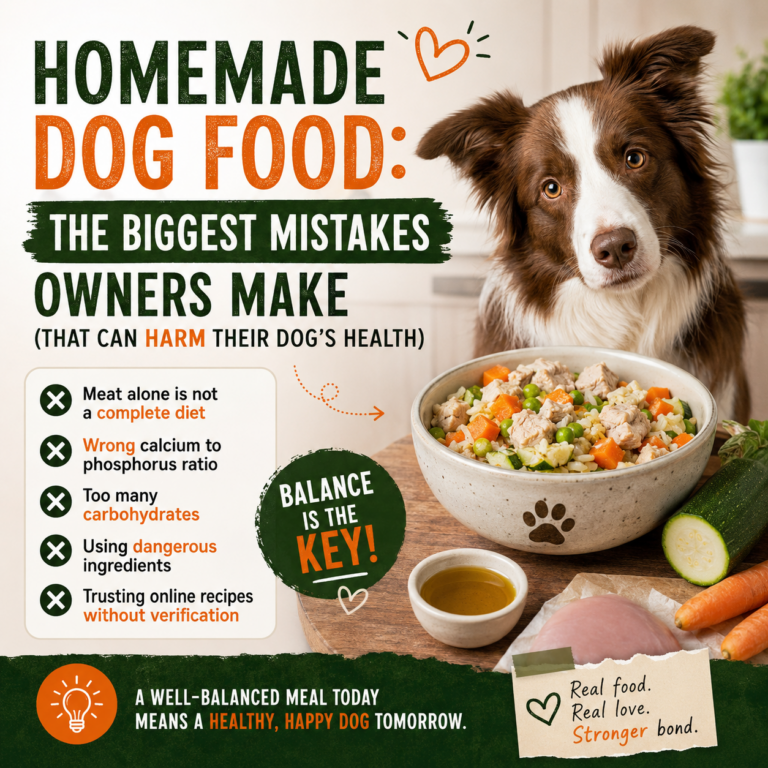
If you enjoy preparing food for your dog, you may also like my guide to homemade dog food mistakes.
Common Mistakes Owners Make When Feeding Human Foods
Even owners with the best intentions can make mistakes.
Here are some I believe are worth paying attention to.
Adding too many new foods at once
If your dog develops loose stools after eating several unfamiliar ingredients, how will you know which one caused the problem?
Introduce one food at a time, starting with a small amount.
Assuming natural means completely safe
Many natural foods are safe for dogs, but others can be dangerous.
Grapes, raisins, onions, garlic, chocolate, and products containing xylitol should never be offered as treats.
Forgetting about calories
Healthy food still contains calories.
A dog doesn’t need unlimited amounts of salmon or eggs just because they’re nutritious.
Feeding from the table
When dogs regularly receive food while people are eating, they may learn to beg.
It’s usually better to offer any approved extras in the dog’s own bowl or as part of planned training rewards.
Trying to solve health problems with food alone
If your dog is losing weight, has ongoing digestive problems, seems unusually tired, or develops changes in appetite, don’t assume that adding a nutritious ingredient will fix the problem.
A veterinary examination may be necessary.
What Actually Helps Dogs Live Longer?
I wish I could tell every dog owner that adding one special ingredient to the food bowl would guarantee a few extra years together.
But that’s not how healthy aging works.
Nutrition is important, but it’s only one part of the picture.
The habits that deserve attention include:
Maintaining a healthy body weight. Excess weight increases the risk of several health problems. Research has also associated leaner body condition with longer lifespan in dogs, although individual outcomes vary.
Providing a complete and balanced diet. Your dog’s regular food should supply the nutrients needed for their life stage and health.
Daily physical activity. Walks, play, and appropriate exercise help support physical fitness and mental well being.
Mental stimulation. Dogs need opportunities to explore, sniff, learn, and interact with their environment.
Preventive veterinary care. Regular examinations, dental care, parasite prevention, and timely treatment of illness matter.
A safe and comfortable environment. Good rest, predictable routines, and positive interactions contribute to quality of life.
And of course, there’s the relationship we build with our dogs.
The little routines.
The walks.
The games.
The moments when they sit beside us, waiting hopefully for a tiny piece of cabbage.
Those moments may not be measurable in nutrients or calories.
But they’re a big part of what makes life with dogs so special.
Frequently Asked Questions
There is no single healthiest human food for every dog. Plain cooked eggs, carrots, pumpkin, blueberries, sardines, and salmon can provide useful nutrients, but the best choice depends on your dog’s needs and existing diet.
No individual human food has been proven to extend a dog’s lifespan. However, a balanced diet, appropriate calorie intake, healthy body weight, exercise, and preventive veterinary care can support long term health.
Some dog safe foods can be offered regularly in carefully controlled amounts, provided they fit within the dog’s overall nutritional plan. Treats and extras should generally contribute no more than 10% of daily calories.
Both provide protein and omega 3 fatty acids. Their nutritional composition varies by product and preparation. Neither is automatically better for every dog.
Plain pumpkin may help some dogs with mild stool irregularities, but it is not a treatment for all causes of diarrhea. Persistent or severe symptoms require veterinary attention.
Plain kefir contains live cultures, but the evidence for specific health benefits in dogs is limited. Veterinary probiotic products with studied strains may be more appropriate when a probiotic is medically indicated.
Yes, healthy dogs can generally eat small amounts of plain cabbage. However, larger quantities may cause gas or digestive discomfort. Avoid cabbage prepared with onions, garlic, rich sauces, or seasonings.
Not without a properly formulated feeding plan. Homemade diets can be nutritionally incomplete even when made with healthy ingredients. If you want to prepare your dog’s main meals at home, work with a board certified veterinary nutritionist.
Final Thoughts: Healthy Dogs Need Balance, Not Miracle Foods
There is nothing wrong with wanting to give your dog the healthiest possible food.
I understand that completely.
But after years of caring for dogs, I’ve learned that good nutrition doesn’t have to be complicated.
Sometimes, a small piece of carrot or a little cooked egg can be a perfectly good treat.
Other times, the best thing you can do is leave your dog’s balanced diet exactly as it is.
Don’t feel pressured to add every superfood you read about.
Pay attention to your dog.
Their appetite.
Their weight.
Their digestion.
Their energy.
And how they respond to changes.
Because the goal isn’t to fill your dog’s bowl with as many healthy ingredients as possible. It’s to give them what they actually need.
A long, healthy life is never guaranteed.
But thoughtful everyday choices can help us give our dogs the best care possible.
And that’s worth far more than any miracle food.
Save this guide for the next time you’re wondering which foods from your kitchen are safe to share with your dog.
Veterinary and Scientific Sources
- WSAVA Global Nutrition Guidelines — Guidance on nutritional assessment and appropriate feeding.
- Tufts University Petfoodology — Evidence based information about pet nutrition, treats, supplements, and homemade diets.
- FDA: Get the Facts! Raw Pet Food Diets Can Be Dangerous to You and Your Pet — Food safety information about raw animal products.
- ASPCA Animal Poison Control — Information about potentially toxic foods and substances.
- Kealy et al., 2002, Effects of Diet Restriction on Life Span and Age Related Changes in Dogs — Research examining calorie restriction, body condition, and longevity in Labrador Retrievers.
This article is intended for general educational purposes and does not replace veterinary advice. Dogs with medical conditions, food allergies, or prescription diets may require different feeding recommendations.