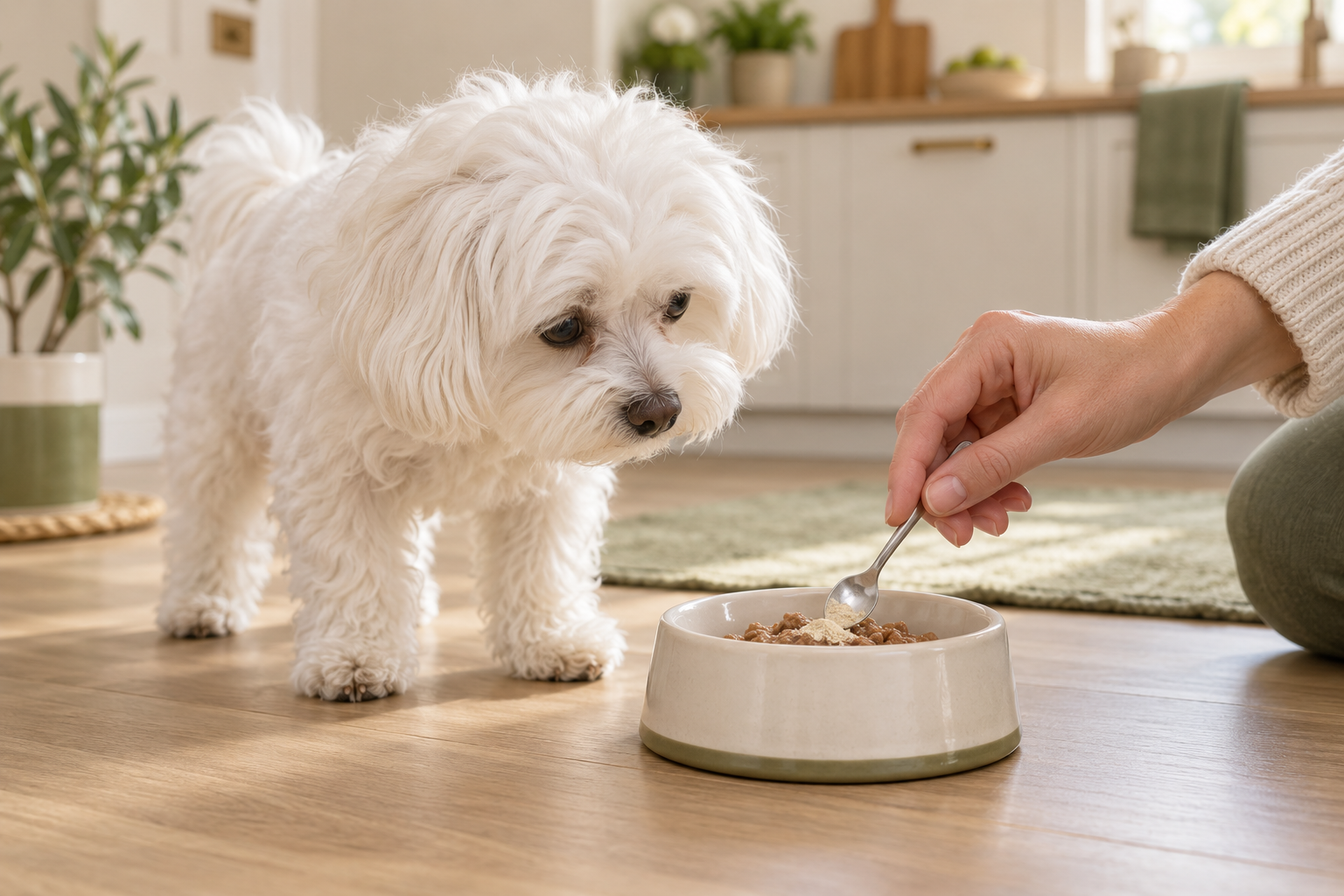
How to Get a Picky Small Dog to Eat Powdered Supplements
You bought a quality supplement, carefully measured the recommended amount, and sprinkled it over your dog’s food. Your dog walked up to the bowl, sniffed it, looked at you as if you had tried to trick him, and walked away.
The food he normally finishes in a few minutes has suddenly become completely unacceptable.
If you live with a picky small dog, this scene probably feels very familiar.
Small dogs often have an incredible sense of smell and an even better ability to find the exact thing you tried to hide in their food. A supplement may seem almost odorless to us, but your dog can immediately tell that his dinner is not the same.
The good news is that you do not have to pour a powdered supplement over the entire meal and hope for the best. The easiest way to get a picky small dog to eat powdered supplements is to mix the measured amount into a tiny portion of familiar, tasty food.
With a few simple tricks, you can make it more likely that your dog will eat it without turning every meal into another round of negotiations.
Why Does a Small Dog Refuse Food With a Supplement?
The most common reason is not that your dog is stubborn.
Powdered supplements can change:
- the smell of the food
- the taste
- the texture
- the moisture in the meal
- the appearance of the food your dog is used to
Some have a strong fish, liver, seaweed, or herbal smell. Others leave a slightly bitter taste or a dry, powdery texture.
A dog who is not usually very picky may eat everything without a second thought. A small dog who already inspects every piece of food carefully may reject the whole bowl because of a very small amount of powder.
The problem can be even worse if you add the full amount the first time you offer the supplement. Yesterday, your dog got his usual dinner. Today, he has been given a meal that smells completely different. Of course he is going to be suspicious.
First, Make Sure Your Dog Really Needs the Supplement
Before you start thinking of ways to hide the supplement, make sure it is appropriate for your dog.
Just because a product is natural does not automatically mean that every dog needs it or that it can be combined with every medication and supplement. Product quality can also vary, so it is best to discuss the product and the correct amount with your veterinarian, especially if your dog has a health condition, takes medication, or eats a veterinary diet. Veterinary sources such as VCA Animal Hospitals also recommend choosing products and manufacturers carefully.
Supplements also cannot automatically correct an unbalanced diet, especially when meals are prepared at home. These common homemade dog food mistakes are worth checking before adding several products to your dog’s bowl.
Always read the directions on the package. Some supplements should be given with a meal, some on an empty stomach, and certain products should not be mixed with hot food.
Do not increase the amount on your own because your dog ate only part of his meal the day before. If you are not sure how much of the supplement your dog consumed, contact your veterinarian or the product manufacturer.
Do Not Put the Supplement in the Entire Meal
This is the most important practical tip.
If you mix the supplement into the entire bowl and your dog eats only half of the food, you will not know how much he actually consumed. You may also ruin his whole dinner.
Instead, prepare a very small amount of food, just two or three bites, and mix the measured amount of supplement into it.
Once your dog eats that small portion, offer the rest of his usual meal without the powder.
This method has several advantages:
- it makes the smell of the supplement easier to hide
- you know your dog has eaten the full amount
- you do not have to throw away the entire meal if he refuses it
- your dog gets food with a familiar taste afterward
Mix the full measured amount into just one or two teaspoons of familiar wet food. Offer the rest of the meal only after your dog finishes this small portion. This makes it much easier to see whether he has eaten the entire amount.
This is especially important for small dogs. If a dog who weighs only a few pounds leaves half of his food, the difference between a full amount and half an amount can be significant.
Make a Small Creamy Mixture
Powder sprinkled over dry kibble is easy to notice. It stays on the surface, sticks to your dog’s nose, and may cause him to lick his nose, sneeze, and decide that he is never going near that bowl again.
A much better option is to mix it into a small amount of moist food your dog already loves.
You can try:
- a teaspoon of his usual wet food
- a small amount of plain pumpkin puree
- a small piece of mashed banana
- a teaspoon of plain yogurt, if your dog tolerates it well
- a little cooked, mashed chicken
- a teaspoon of recovery food recommended by your veterinarian
The ingredient you use should not contain sugar, seasoning, onion, garlic, or artificial sweeteners.
If you use peanut butter, always check the ingredient list. It must not contain xylitol, which is extremely dangerous for dogs. Peanut butter is also high in calories and fat, so a very small amount is enough for a small dog.
The goal is not to make a new meal. You only need a small, tasty spoonful for the supplement.
Add a Few Drops of Liquid
Some supplements are difficult to mix with food. The powder may stay dry or form small lumps that your dog can separate with his tongue.
If the product directions allow it, add a few drops of water or a little unsalted broth made for dogs. You only need enough to create a creamy mixture that sticks to the food.
Do not put the supplement into a full bowl of water. If your dog does not drink all of it, you will not know how much he consumed. The powder may also settle at the bottom, while the unusual smell could make your dog less willing to drink.
Fresh water should always remain available. It is better to give the supplement in a small, controlled portion of food.
Start With a Very Small Amount
If the manufacturer or your veterinarian has not said that the full amount must be introduced immediately, ask whether you can introduce the supplement gradually.
On the first day, you may be able to add only a small amount of powder to the food. Once your dog accepts the new smell and taste, you can gradually increase it until you reach the recommended amount.
This approach can also be helpful for dogs with sensitive stomachs.
However, not every product should be introduced in the same way. If the supplement is being used for a particular health condition, discuss the plan with your veterinarian first. A gradual introduction does not mean that you should change a prescribed amount on your own.
Choose a Flavor That Can Hide the Smell
Mild food will not always cover the strong smell of a supplement.
If the powder smells like fish, it may blend well with fish based wet food. A supplement with an herbal smell may be easier to hide in a small amount of dog pâté than in plain kibble.
It is important not to try five new foods at once. If your dog gets soft cheese, yogurt, chicken, tuna, and peanut butter just because he is supposed to eat a supplement, he may quickly learn that refusing his food leads to better and better offers.
Choose one safe food that your dog already tolerates well and use only a small amount.
Make a Bite Your Dog Cannot Take Apart
Some dogs eat the tasty part and leave the supplement in the bowl. They really are talented.
If this happens, make the mixture thick enough that your dog cannot easily separate the powder. You can shape it into one or two very small balls.
For example, mash a small piece of cooked chicken, add a little wet food, and mix the supplement in thoroughly. The ball should be small enough for your dog to eat safely, but not so large that he chews it and examines it for several minutes.
You can offer the first bite without the supplement, the second one with the supplement, and the third one without it again. When your dog is expecting another tasty bite, he is less likely to spend a long time inspecting the middle one.
Of course, do not rush your dog or push food down his throat. The goal is for him to accept the supplement willingly and without stress.
Turn Supplement Time Into a Short Routine
Dogs like predictable things.
If you make a big production out of it every day, call your dog several times, beg him to eat, and stare anxiously at the bowl, he will quickly realize that something unusual is going on.
Prepare a small bite, offer it calmly, and act as if it is a completely normal part of the day. Once your dog eats it, praise him and immediately offer the rest of his meal.
You can also use a simple cue, such as “vitamins” or “your supplement,” but do not add pressure or repeat it ten times.
The calmer the routine is, the less likely your dog is to decide in advance that something is wrong.
Can You Put a Supplement on a Lick Mat?
Yes, but only if your dog licks up the entire small portion.
Mix the supplement thoroughly into a very thin layer of wet food and use only a small section of the mat. If you spread the mixture over the entire surface, some of it will probably remain deep in the grooves.
For accurate amounts, a small bowl or one prepared bite is often a more practical option.
A lick mat can be useful for dogs who enjoy licking creamy food, but it is not a good solution if your dog quickly loses interest and leaves half of the mixture behind.
If your dog already enjoys this type of enrichment, try one of these easy pumpkin lick mat recipes for small dogs, but keep the supplement portion small enough to make sure he finishes it.
Do Not Heat the Supplement Without Checking the Directions
Warm food has a stronger smell and may be more appealing to a picky dog. However, that does not mean you should add the supplement before heating the food.
The correct method depends on the product. Heat can affect the ingredients in some supplements, while other products can be mixed with warm food.
It is usually safer to warm the food gently, wait until it is no longer hot, and then add the powder, but only if this follows the product directions.
With probiotics and similar products, check the label and the recommended temperature especially carefully.
What if Your Dog Refuses Every Attempt?
If you have tried several safe methods and your dog still refuses the supplement, do not continue an endless battle over the food bowl.
Ask your veterinarian whether the same or a similar product is available in another form:
- as a soft chew
- in a capsule
- as a liquid
- as a paste
- as a powder with a different flavor
- in a smaller, more concentrated amount
Powder works well for some dogs, while others will accept a capsule hidden in a small bite much more easily. There is no special prize for the owner who manages to outsmart a dog with one particular type of supplement.
The best form is one that is safe, suits your dog’s needs, and can be given consistently.
Common Mistakes When Giving a Powdered Supplement
Sprinkling the Powder Over the Entire Bowl
If your dog refuses the meal, you lose both the food and the supplement.
Offering Tastier Food After Every Refusal
Your dog may learn that waiting pays off. He gets chicken today, cheese tomorrow, and expects a restaurant menu the day after that.
Mixing the Supplement With Unsafe Foods
Human food may contain too much salt, seasonings, onion, garlic, or xylitol.
Giving Another Full Amount
If you are not sure how much your dog ate, do not automatically give another full amount.
Mixing Several Supplements Without Checking
Several products may contain the same vitamins or minerals. When combined, they may provide more than your dog needs.
Forcing a Dog Who Shows Signs of Nausea
If your dog approaches the food, licks his lips, turns his head away, drools, or tries to eat and then stops, he may not simply be picky. This behavior can be a sign of nausea, pain in the mouth, or another problem.
When Should You Talk to Your Veterinarian?
Contact your veterinarian if your dog refuses not only the supplement but also his usual food, especially if you notice:
- vomiting or diarrhea
- excessive drooling
- weight loss
- tiredness or a lack of interest
- pain while chewing
- bad breath
- changes in thirst or urination
- itching, swelling, or another reaction after taking the supplement
Sudden picky eating in a dog who used to eat well should not automatically be blamed on his personality.
Small dogs cannot safely go without food for as long as some owners assume. You should be especially careful with puppies, very tiny dogs, senior dogs, and dogs with chronic health conditions.
What Usually Works Best in Real Life?
In my experience, the simplest method usually works best: use a small amount of a favorite moist food, mix the supplement in thoroughly so there are no dry areas, and offer the rest of the meal only after your dog eats that first portion.
This way, you know the full amount was eaten, you do not change the taste of the entire dinner, and you do not teach your dog that refusing food always leads to a tastier offer.
For a picky small dog, the amount of food used to hide the supplement should be as small as possible but tasty enough to cover the smell. Sometimes one carefully prepared spoonful works much better than a full bowl.
Frequently Asked Questions About Powdered Supplements for Small Dogs
You can if the product directions allow it, but the powder often falls to the bottom of the bowl. It is better to moisten a very small amount of kibble or mix the supplement into a teaspoon of wet food first.
Only if the product directions say you can. Do not put it in your dog’s main water bowl because you may not know how much he consumed, and the changed taste may make him less interested in drinking.
A small amount of plain, unsweetened yogurt may be suitable for a dog who tolerates dairy products well. Make sure it does not contain xylitol or other added ingredients, and do not use it if dairy gives your dog gas or diarrhea.
Do not immediately give another full amount. You cannot know exactly how much your dog has already consumed. Contact your veterinarian or the product manufacturer for advice.
Only if your veterinarian has confirmed that they can be combined. Different products may contain the same ingredients, which can lead to unnecessary amounts of certain vitamins or minerals.
If your dog refuses every safe method for several days, talk to your veterinarian about a different form or flavor. A supplement will not help much if most of it regularly stays in the bowl.
Final Thoughts
Your picky small dog is not trying to make your life difficult. He simply notices the change you hoped he would not notice.
Do not hide the supplement in a large amount of food, do not change the amount on your own, and do not offer more valuable treats after every refusal. Start with a small portion that has been mixed thoroughly, use a familiar and safe food, and create a calm daily routine.
And if your dog still manages to lick everything around the powder and leave the supplement sitting in a perfectly clean circle, do not be angry.
That is not disobedience. That is talent.
Disclaimer: This article is for general informational purposes only and is not a substitute for professional veterinary advice. Always check with your veterinarian before adding a new supplement or changing the recommended amount, especially if your dog has a health condition or takes medication.