How to Brush a Dog That Hates Being Brushed: A Gentle 7-Day Plan
Does your dog run away when you pick up the brush? Learn how to make brushing less stressful with a gentle, reward-based 7-day plan that helps build trust, one small step at a time.
You pick up the dog brush, and suddenly your sweet little companion disappears under the table.
Or perhaps your dog stays beside you but turns their head, pulls away, growls, or tries to bite the brush.
Sound familiar?
Many dog owners assume their dogs are simply being difficult. But a dog that hates being brushed is usually trying to communicate discomfort, fear, frustration, or a negative association with grooming.
And the solution isn’t to hold your dog tighter or finish brushing as quickly as possible.
It’s to change how your dog feels about the experience.
The good news? With patience, gentle handling, and positive reinforcement, many dogs can learn to feel more comfortable with brushing.
This 7-day plan will show you where to start, what to avoid, and how to recognize progress.
One important thing before we begin: Seven days is a starting framework, not a deadline. Some dogs need several weeks or longer, especially if they have experienced painful grooming or significant fear.
Your goal isn’t to brush your dog’s entire coat by Day 7.
Your goal is to help your dog feel safe enough to try.
Why Does My Dog Hate Being Brushed?
Before trying to change your dog’s behavior, it’s important to understand what might be causing it.
Dogs don’t suddenly decide that grooming should become a daily battle.
Usually, there’s a reason behind their reaction.
1. Brushing may have hurt in the past
Imagine someone pulling a comb through your tangled hair without warning.
It wouldn’t take long before you started avoiding that experience.
Dogs can feel the same way.
A brush that catches in a knot, pulls at sensitive skin, or repeatedly scratches the same area can make grooming uncomfortable.
Even one painful experience may create a negative association.
This is particularly important for small breeds with delicate skin or coats that tangle easily.
2. Your dog doesn’t understand what’s happening
Some puppies and adult dogs have never been gradually introduced to grooming tools.
A strange object suddenly moving across their body can feel confusing or threatening.
They may try to escape simply because they don’t know what to expect.
3. You’re using the wrong brush
Not every brush works for every dog.
A tool that works beautifully on a thick double coat may be uncomfortable or unsuitable for a short-haired Boston Terrier.
Likewise, a soft grooming glove may feel pleasant on a short coat but won’t remove deeper tangles from a Bolognese or Yorkshire Terrier.
The right brush should match your dog’s coat type, skin sensitivity, and grooming needs.
4. Your dog feels trapped
Some dogs become frightened when they’re held still, restrained, or placed on a slippery grooming table.
Others dislike having their paws, belly, ears, or tail handled.
If your dog learns that seeing the brush means losing control over their body, they may begin avoiding grooming altogether.
5. There may be an underlying health problem
Sometimes, resistance to brushing is related to physical discomfort.
Possible causes include:
- Skin irritation or infection
- Painful mats close to the skin
- Arthritis or joint pain
- Ear infections
- Injuries or sensitive areas
- Other conditions that make touch uncomfortable
Important: If your dog suddenly starts resisting brushing after previously enjoying it, or reacts painfully when a particular area is touched, contact your veterinarian before continuing.
Training cannot solve a medical problem.
What You’ll Need Before Starting the 7-Day Plan
You don’t need expensive grooming equipment to begin.
In fact, starting with fewer tools can make the process easier.
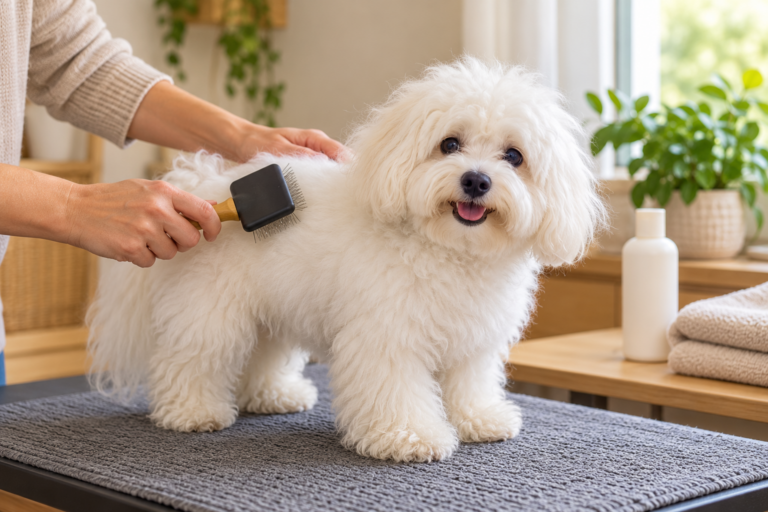
Prepare a quiet room, a comfortable non-slip mat, a suitable soft brush or grooming glove, and a few rewards your dog genuinely enjoys.
Small, tasty treats are useful, but they aren’t the only option.
Some dogs prefer gentle praise, petting, or a favorite toy.
Choose something your dog finds rewarding.
Not every dog is motivated by food. If treats don’t work for your dog, discover what really counts as a reward for a dog and how to use it during training.
You can also use a lick mat with a small amount of dog-safe food. However, never use food to distract your dog while continuing something that clearly frightens or hurts them.
Your dog should still have the freedom to move away.
Which brush should you choose?
| Coat type | Tool to consider | Important tip |
|---|---|---|
| Short, smooth coat, such as a Boston Terrier | Soft rubber brush or grooming glove | Use gentle pressure |
| Long, silky coat, such as a Yorkshire Terrier | Suitable soft slicker brush and comb | Work through small sections |
| Soft, fluffy coat, such as a Bolognese | Gentle slicker brush and metal comb | Check for hidden tangles |
| Thick double coat, such as a Pomeranian | Coat-appropriate slicker, comb, or undercoat tool | Avoid pulling or scraping the skin |
A professional groomer can help you select the right tools for your dog’s individual coat.
Choosing the right brush is only the beginning. If you’re unsure how to care for your dog’s coat, read our guide on how to groom your dog’s coat for more practical grooming tips.
Remember, the softest brush isn’t always sufficient for preventing mats.
The Gentle 7-Day Brushing Plan
The following exercises use two established behavior-training techniques: desensitization and counterconditioning.
Desensitization means introducing something gradually, at a level your dog can comfortably handle.
Counterconditioning means helping your dog associate something previously unpleasant with a positive experience.
Together, these techniques can help change your dog’s emotional response to grooming.
Keep initial practice sessions very short, sometimes just 10 to 30 seconds.
Move forward only when your dog is comfortable with the previous step.
Day 1: Let Your Dog See the Brush Without Being Brushed
Today, you won’t brush your dog at all.
Yes, really!
Sit somewhere comfortable and place the brush on the floor at a distance where your dog notices it but remains relaxed.
Allow your dog to look at it or approach it voluntarily.
Don’t push the brush toward their face.
When your dog notices the brush and remains comfortable, offer a reward.
Then put the brush away.
Repeat this a few times if your dog is happy to continue.
Today’s goal: Your dog can see the brush without becoming frightened or trying to escape.
If your dog runs away as soon as the brush appears, increase the distance and make the exercise easier.
Day 2: Make the Brush Predict Something Good
Today, we’ll begin creating a more positive association.
Show your dog the brush briefly.
Immediately offer a small treat or another favorite reward.
Put the brush behind your back or out of sight.
Repeat several times.
The sequence should be simple:
Brush appears → something good happens → brush disappears.
Watch your dog’s body language.
A relaxed posture, voluntary approach, and willingness to engage are encouraging signs.
If your dog freezes, backs away, or refuses food they normally enjoy, the exercise may be too difficult.
Today’s goal: Your dog remains comfortable when the brush appears nearby.
Don’t worry if your dog isn’t ready for physical contact.
There’s no reason to rush.
Day 3: Introduce Gentle Touch Without Brushing
Before using the brush, make sure your dog is comfortable being touched.
Invite your dog onto a non-slip mat.
Gently stroke an area they normally enjoy having touched, such as the shoulder or side of the body.
Offer a reward.
Pause.
If your dog remains relaxed and voluntarily stays, repeat.
You can also briefly touch your dog with your empty hand while holding the brush in your other hand, provided the brush itself doesn’t cause anxiety.
Avoid sensitive areas for now.
Today’s goal: Your dog comfortably accepts gentle handling while the brush is present.
If your dog moves away, let them.
Giving your dog a choice helps build trust.
Day 4: Try One Gentle Brush Stroke
This is the day many owners have been waiting for.
But we’re only going to try one stroke.
Choose an area where your dog already enjoys being touched.
For many dogs, the shoulder or upper back is a good starting point.
Let your dog see the brush.
If they remain relaxed, gently move it once through a small section of untangled fur, following the direction of hair growth.
Immediately offer a reward.
Then stop.
That’s it.
One successful brush stroke is better than twenty uncomfortable ones.
If your dog moves away before contact, return to the previous day’s exercise.
Today’s goal: Your dog comfortably accepts one gentle brush stroke.
Day 5: Build Up to a Few Brush Strokes
If yesterday went well, you can try two or three gentle strokes.
Offer a reward after each stroke initially.
Pause between strokes to give your dog a chance to move away.
Don’t hold your dog in place.
Watch for subtle changes in body language.
A dog that becomes stiff, turns their head away repeatedly, or suddenly stops engaging may be telling you the session is becoming uncomfortable.
End the exercise before your dog feels the need to struggle.
Today’s goal: Your dog remains relaxed during a few brief strokes.
Remember that staying still doesn’t automatically mean your dog is comfortable.
Look at their whole body, not just whether they move.
Day 6: Introduce Another Easy Area
By now, your dog may be beginning to understand that brushing doesn’t have to be frightening.
Today, you can gently introduce another comfortable area of the body.
For example, if you’ve been brushing the shoulder, try a small section along the side.
Keep the session short.
Don’t immediately move to the paws, ears, belly, or tail.
These areas may require separate training steps.
If your dog has a long coat, you can begin practicing with the appropriate comb on an untangled section, but only if your dog is already comfortable with the brush.
Today’s goal: Your dog accepts gentle brushing in more than one easy area.
Day 7: Create a Calm Brushing Routine
Today isn’t a final examination.
It’s the beginning of a routine you can continue.
Invite your dog to their grooming mat.
Show the brush, offer a reward, and gently brush a small section of fur.
Pause regularly.
If your dog remains comfortable, you can gradually increase the amount of brushing over future sessions.
For dogs with longer coats, eventually you’ll need to learn how to brush through the coat in sections rather than only smoothing the surface.
But don’t try to accomplish everything today.
Today’s goal: Your dog voluntarily participates in a short, predictable grooming session.
If your dog is still working on Day 2 or Day 3, that’s perfectly fine.
Progress is measured by comfort, not the calendar.
How to Know If Your Dog Is Comfortable or Stressed
One of the most valuable grooming skills is learning to read your dog’s body language.
Dogs often communicate discomfort long before they growl or snap.
| Signs your dog may be comfortable | Signs your dog may need a break |
|---|---|
| Relaxed body and muscles | Stiff or frozen posture |
| Voluntarily approaches the grooming area | Moves away or tries to hide |
| Accepts rewards normally | Suddenly refuses favorite treats |
| Remains engaged and can move freely | Repeatedly turns away |
| Chooses to return after a pause | Trembles, growls, or snaps |
Other possible stress signals include repeated lip licking, yawning when not tired, pinned ears, and showing the whites of the eyes.
Always consider the context. One signal alone doesn’t necessarily mean fear.
My rule for gentle grooming: If your dog is clearly asking for a break, listen.
Stopping doesn’t mean you’ve failed.
It means you’ve noticed what your dog needs.
My Experience With Small Dogs: Grooming Should Never Become a Battle
After approximately 15 years of working with and caring for small dogs, including Bolognese and Boston Terriers, I’ve learned how important it is to pay attention to each dog’s individual preferences.
Small dogs may look easy to handle because of their size, but that doesn’t mean they enjoy being held still or having every part of their body touched.
And two dogs of the same breed can react very differently to grooming.
One may happily enjoy attention and gentle brushing, while another needs much more time to feel comfortable.
I believe one of the biggest mistakes owners can make is focusing only on finishing the grooming session.
When we concentrate on getting the coat brushed as quickly as possible, it’s easy to miss the small signals telling us our dog has had enough.
Over the years, I’ve come to value patience and trust far more than a perfectly brushed coat achieved through force.
Of course, regular coat care is essential, especially for breeds prone to tangles.
But I would rather build a routine a dog can comfortably participate in than turn brushing into something they dread.
A beautiful coat matters. A dog that feels safe matters even more.
What If Your Dog Has Mats but Won’t Let You Brush Them?
This is where owners need to be especially careful.
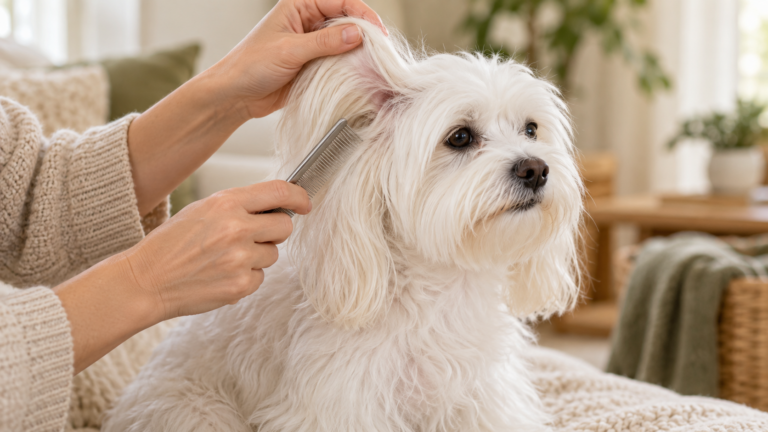
Long-haired small dogs can be especially prone to tangles behind their ears. Learn how to prevent mats behind your small dog’s ears before they become painful and difficult to remove.
Matted fur isn’t simply a cosmetic problem.
Tight mats can pull on the skin, cause discomfort, trap moisture, and hide irritation.
Some dogs resist brushing because the mats themselves are painful.
Trying to force a brush through them may make the situation worse.
If your dog has severe mats, tightly tangled fur close to the skin, or visible irritation, don’t attempt to remove them with scissors.
Dog skin can become caught inside a mat, making accidental cuts a serious risk.
Contact a qualified professional groomer or veterinarian for safe removal.
If your dog is severely frightened or likely to bite, explain this before the appointment so appropriate handling can be arranged.
The 7-day plan is designed to build comfort with grooming. It isn’t a substitute for necessary professional coat care.
7 Common Mistakes That Make Dogs Hate Brushing Even More
Even caring owners sometimes make mistakes without realizing it.
Here are seven worth avoiding.
1. Holding your dog down. Physical restraint may allow you to finish grooming, but it can increase fear and make future sessions more difficult.
2. Brushing through painful tangles. Never pull harder simply because the brush gets stuck.
3. Starting with sensitive areas. Paws, ears, belly, and tail are often more difficult than the shoulders or back.
4. Using the wrong grooming tool. A brush that doesn’t match the coat type can cause unnecessary discomfort.
5. Making sessions too long. A few comfortable strokes are more useful during training than an exhausting grooming session.
6. Ignoring early stress signals. Don’t wait until your dog growls or snaps before taking a break.
7. Expecting progress every single day. Learning isn’t always a straight line. Some days will be easier than others.
One more thing: Never punish a dog for growling during grooming.
Growling is communication.
Instead of suppressing the warning, identify why your dog feels uncomfortable and make the situation safer.
How Often Should You Brush Your Dog Once They Feel Comfortable?
The answer depends on your dog’s coat.
Some short-haired dogs need relatively little brushing, while long-haired breeds may require daily attention to prevent tangles.
Here’s a general guide.
| Dog or coat type | Typical brushing needs |
|---|---|
| Boston Terrier and similar smooth-coated breeds | About once a week, adjusted for shedding |
| Yorkshire Terrier with a long coat | Often daily |
| Bolognese with a longer coat | Frequent brushing, often daily |
| Pomeranian and similar double-coated breeds | Several times weekly, adjusted for coat and shedding |
These are general guidelines, not strict rules.
Coat length, activity, skin condition, shedding, and grooming style all affect the schedule.
If your dog still finds brushing stressful, don’t force a full session just to meet a daily target.
Work with a groomer to keep the coat manageable while you continue gentle training.
For more guidance, read How Often Should You Bathe a Small Dog? A Practical Guide by Coat Type.
Can You Use a Lick Mat While Brushing?
Yes, a lick mat can be useful for some dogs.
Spreading a small amount of dog-safe food onto a lick mat may help create a pleasant grooming experience.
However, there’s an important difference between helping your dog relax and distracting them while doing something painful.
A lick mat should never become a reason to ignore stress signals.
If your dog stops licking, stiffens, tries to escape, or shows other signs of discomfort, pause the grooming session.
Always check ingredients carefully. Peanut butter, for example, must be free from xylitol, which is toxic to dogs.
For a simple homemade option, explore our Easy Pumpkin Lick Mat Recipe for Small Dogs.
What If Your Dog Still Hates Brushing After Seven Days?
First, don’t assume the plan has failed.
A dog with a history of frightening or painful grooming experiences may need much longer.
Return to the last step where your dog was genuinely comfortable.
Practice that step until it becomes easy.
You may also need to adjust the brush, grooming location, reward, or time of day.
If your dog continues to panic, freezes repeatedly, growls, or attempts to bite, seek help from a veterinarian and a qualified reward-based behavior professional.
A fear-free or cooperative-care-focused groomer can also be a valuable part of the process.
For some dogs, the safest long-term solution combines professional coat maintenance with gradual training at home.
Frequently Asked Questions
Your dog may be frightened, uncomfortable, overstimulated, or reacting to a painful sensation. Stop brushing and check for possible skin or coat problems. If biting continues, seek professional guidance rather than forcing the interaction.
Yes. Older dogs can learn new associations with grooming, although dogs with long-standing fear may need more time. If an older dog suddenly resists touch, rule out pain or medical conditions first.
Not necessarily. Daily gentle training may be useful, but forcing daily brushing can make fear worse. Dogs with coats that mat easily still need appropriate coat maintenance, so consult a groomer about safe care during training.
A grooming glove may be easier for some dogs to accept, especially those with short coats. However, it may not remove tangles or prevent mats in long or dense coats. Choose tools based on both your dog’s comfort and coat needs.
During early training, rewards can be given when the brush appears and immediately after brief, comfortable contact. The goal is to create a positive association, not to persuade a frightened dog to endure painful brushing.
Don’t chase your puppy. Start by placing the brush at a comfortable distance and rewarding relaxed behavior. Gradually introduce closer contact over several sessions.
Some dogs make progress within days, while others need weeks or longer. The timeline depends on their previous experiences, sensitivity, health, and how consistently you work at a comfortable pace.
Final Thoughts: Your Dog Doesn’t Need Perfect Brushing. They Need Your Patience.
If your dog hates being brushed, remember that you’re not simply teaching a grooming skill.
You’re helping your dog feel safer during something they currently find uncomfortable.
And that takes time.
Some days, progress might mean three gentle brush strokes.
Other days, it might mean your dog calmly looking at the brush without running away.
Both are worth celebrating.
Don’t compare your dog to another dog that happily lies still during grooming.
Every dog has a different personality, history, and comfort level.
The most important change isn’t how much fur you brush. It’s how your dog feels when they see the brush.
When your dog begins approaching the grooming area voluntarily, staying relaxed, and trusting you to respect their signals, you’re building something far more valuable than a tidy coat.
You’re building trust.
And that trust can make grooming, handling, and everyday care easier for years to come.
Have you ever had a dog that ran away at the sight of a brush? What helped them feel more comfortable? Share your experience in the comments. Your story might help another dog owner.
Sources and Further Reading
- RSPCA – Why and How Should I Groom My Dog?
- Cornell University – Grooming and Cooperative Care
- VCA Animal Hospitals – Desensitization and Counterconditioning
- American Kennel Club – Why Does My Dog Dislike Being Brushed?
- VCA Animal Hospitals – Grooming and Coat Care for Your Dog
- Fear Free – How to Brush Your Dog the Fear Free Way
Disclaimer: This article provides general grooming and behavior guidance based on established animal welfare recommendations and practical experience with dogs. It does not replace veterinary advice. If your dog shows signs of pain, skin disease, severe fear, or aggressive behavior during grooming, consult a qualified professional.