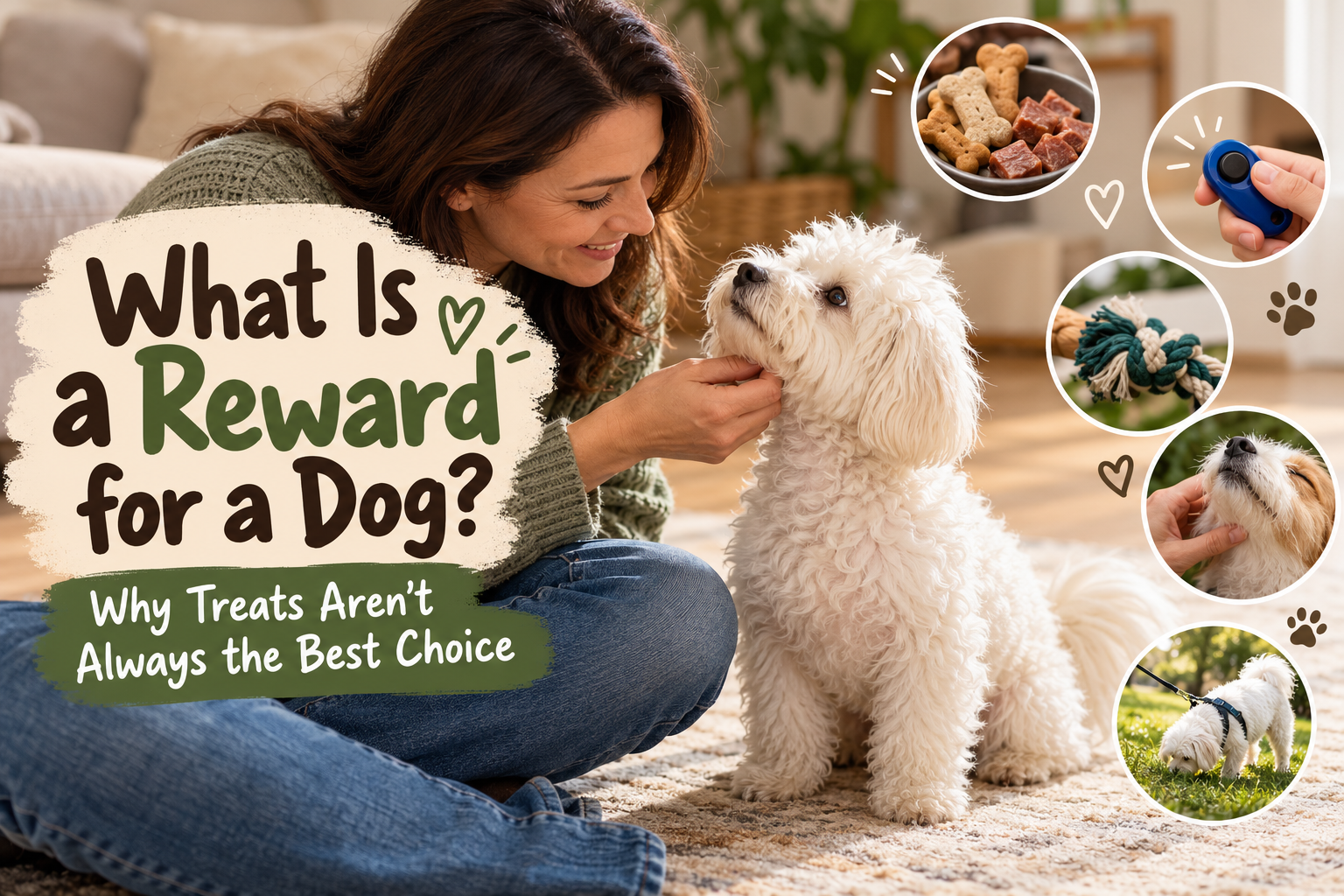
What Is a Reward for a Dog? Why Treats Aren’t Always the Best Choice
Your dog sits when you ask.
You smile, reach into your pocket, and offer a treat.
But instead of taking it, your dog turns their head away.
Now what?
Does that mean your dog isn’t interested in training? Are they being stubborn? Or have you simply offered something they don’t really want?
After more than 15 years of working with dogs, I’ve learned something that every dog owner should understand.
A reward isn’t what you think your dog should enjoy. A reward is something your dog actually wants.
And sometimes, the best reward has nothing to do with food.
What Is a Reward for a Dog?
A reward for a dog is anything that makes a behavior more likely to happen again.
In dog training, this is called positive reinforcement.
When your dog does something you want, you follow that behavior with something they enjoy. Over time, your dog learns that repeating the behavior leads to a pleasant result.
For example:
- Your puppy sits, and you give them a small treat.
- Your dog comes when called, and you start a favorite game.
- Your dog walks calmly beside you, and you allow them to stop and sniff.
- Your puppy responds to a command, and you reward them with gentle affection.
All of these can be rewards.
But there’s one important detail.
The dog decides what is rewarding, not the owner.
A piece of chicken might be irresistible to one dog and completely uninteresting to another.
The same applies to toys, praise, and physical affection.
That’s why understanding your dog’s preferences is just as important as teaching the command itself.
Why Some Dogs Refuse Treats During Training
Many owners are surprised when their dogs refuse food during training.
They assume something must be wrong.
But refusing a treat doesn’t automatically mean your dog is stubborn, disobedient, or uninterested in learning.
There are several possible explanations.
1. Your Dog Isn’t Hungry
This is something I’ve noticed many times, especially when working with small dogs.
Imagine giving your little dog a full meal and then immediately starting a training session.
You offer a piece of kibble as a reward.
Your dog looks at it and turns away.
Why?
They may simply be satisfied.
Some dogs will happily eat treats even after a meal. Others, particularly those with smaller appetites, may show very little interest.
My advice: Try practicing before a regular meal, when your dog is naturally interested in food. Don’t withhold necessary meals to make your dog hungry enough to train.
Keep training sessions short and pleasant.
2. Your Dog Doesn’t Like That Particular Treat
Not all treats are equally valuable.
I’ve worked with dogs that refused one type of treat but happily accepted another.
Sometimes, a dog would ignore commercial treats and become interested in a tiny piece of apple instead.
That doesn’t mean apples are always better than dog treats.
It simply means that particular dog preferred something different at that moment.
If your dog refuses a treat, try another safe option.
Small pieces of plain cooked chicken, regular kibble, or dog-safe fruit may work.
If you offer apple, remove the core and seeds, and cut it into appropriately sized pieces.
You can also prepare simple homemade rewards. If you enjoy making food for your dog, take a look at my guide to homemade dog treats.
Just remember that homemade doesn’t automatically mean healthier. Ingredients, portion sizes, and your dog’s individual needs still matter.
3. Your Dog Is Distracted or Overwhelmed
A dog who happily takes treats at home may refuse the same food outside.
There may be too many distractions.
Other dogs, unfamiliar sounds, new smells, or passing cars can make it difficult to concentrate.
Sometimes, refusing food is also a sign that a dog is frightened or stressed.
If your dog suddenly stops accepting favorite treats during an unfamiliar situation, don’t immediately offer something tastier.
First, look at what’s happening around them.
Move to a quieter place, increase the distance from anything frightening, and give your dog time to relax.
Training should never become a struggle.
4. Food Simply Isn’t Their Favorite Reward
And this brings me to one of my favorite experiences.
From My Experience: The Bolognese Puppy Who Wanted Cuddles Instead of Treats
I remember working with a six-month-old Bolognese puppy.
We were practicing a very simple command: “Sit.”
Each time he sat down, I offered him a piece of kibble.
His reaction?
He turned his head away.
I tried again.
He sat beautifully, but when I offered the food, he refused it.
After two or three attempts, I decided to change my approach.
I put the treats away.
The next time he sat, I gently petted him, spoke to him in a warm, affectionate voice, and gave him the attention he seemed to enjoy.
And something wonderful happened.
He became genuinely enthusiastic about the exercise.
Every time I said “Sit,” he responded eagerly.
He would sit down, wag his tail, and look at me, clearly expecting his favorite reward.
Sometimes, I had the impression that he could hardly wait for me to give the command again.
Not because he wanted food.
He wanted affection.
That little Bolognese reminded me of something I’ve seen throughout my years of working with dogs.
We sometimes become so focused on teaching a command that we forget to observe the dog standing in front of us.
The moment I stopped insisting on food and started using something he genuinely enjoyed, the training became easier and more pleasant for both of us.
Of course, not every dog enjoys being touched during training.
Some dogs prefer toys, movement, or food.
But this puppy taught a valuable lesson.
The best reward is the one your dog looks forward to receiving.
5 Types of Rewards You Can Use in Dog Training
Food is useful, but it isn’t your only option.
Here are five types of rewards worth trying.
1. Food Rewards
Food is one of the easiest rewards to use because it can be delivered quickly and precisely.
Small treats work particularly well when teaching new behaviors.
You can use:
- Pieces of your dog’s regular kibble
- Tiny portions of plain cooked chicken
- Small pieces of dog-safe fruit
- Commercial training treats
- Homemade dog treats made with suitable ingredients
Keep portions small, especially for puppies and small breeds.
Treats should generally make up no more than about 10% of your dog’s daily calorie intake.
For frequent training, you can also use part of your dog’s normal food allowance.
2. Praise and Affection
Some dogs love hearing an enthusiastic “Good job!”
Others enjoy a gentle scratch on the chest or a few seconds of cuddling.
The important thing is to watch their reaction.
Does your dog move closer?
Do they seem relaxed and eager for more?
Or do they turn away, stiffen, or try to move out of reach?
A dog who doesn’t enjoy being touched at that moment may not experience petting as a reward.
Never assume that affection is rewarding simply because you enjoy giving it.
3. Play and Toys
For playful dogs, a favorite toy can be more exciting than food.
You can reward a successful command with:
- A short game of tug
- A quick game of fetch
- A favorite squeaky toy
- A few seconds of playful interaction
This can be especially useful for dogs who are highly motivated by movement and games.
Keep play sessions brief enough that your dog can return to the exercise without becoming overly excited.
4. Sniffing and Exploring
Here’s a reward many owners overlook.
Dogs love exploring the world through their noses.
Imagine you’re walking with your dog.
They begin pulling toward an interesting smell.
Instead of allowing pulling to become the way they reach it, you stop and wait for a moment of loose leash behavior.
Then you say, “Go sniff!” and allow your dog to investigate.
You’ve just used something your dog naturally wanted as a reward for a behavior you wanted.
This can be a wonderful way to make everyday walks more enjoyable.
If your dog struggles with leash walking, read my guide on how to stop your dog from pulling on the leash.
5. Access to Favorite Activities
Sometimes, the reward is simply getting permission to do something enjoyable.
For example:
Your dog waits calmly while you prepare to open the door.
You reward that calm behavior by opening it and inviting them outside.
Or your dog responds to a recall cue during a safe, supervised play session.
You praise them and then allow them to return to playing.
Rewards don’t always have to be objects you carry in your pocket.
They can be everyday experiences your dog values.
How to Find the Best Reward for Your Dog
You don’t need expensive equipment or complicated training methods.
You need to observe your dog.
Try offering several different rewards during short, easy training exercises.
Watch what happens.
| Your dog’s reaction | What it may tell you |
|---|---|
| Immediately takes the treat and wants more | Food may be highly motivating |
| Refuses kibble but accepts chicken | The first food may not be appealing enough |
| Wags their tail and approaches for petting | Affection may be rewarding |
| Becomes excited when you pick up a toy | Play may be a strong motivator |
| Ignores treats outdoors and watches everything around them | Distractions, excitement, or stress may be affecting training |
| Turns away when you try to pet them | Touch may not be welcome at that moment |
Remember that these are clues, not absolute rules.
Look at your dog’s whole body language and what they choose to do next.
A reward that works beautifully in your living room may not be effective at the park.
And that’s perfectly normal.
When Should You Reward Your Dog?
Timing matters.
A lot.
Imagine asking your puppy to sit.
They sit.
You search your pocket for a treat, open the package, and finally give it to them.
But by then, your puppy has already stood up and started jumping.
What exactly did they learn?
Possibly something different from what you intended.
Try to mark the correct behavior the moment it happens, then deliver the reward promptly.
For example:
- Say “Sit” once.
- Wait for your dog to sit.
- Immediately say “Yes!” or use a trained clicker.
- Give the chosen reward.
The marker helps your dog understand exactly which behavior earned the reward.
This is particularly helpful when teaching new skills.
Can You Use a Clicker as a Reward?
I’ve also used clicker training with many small dogs.
And I’ve seen how quickly some of them became interested in that familiar clicking sound.
But there’s an important distinction.
A clicker is primarily a marker, not a replacement for a reward.
At first, the click is just a sound.
To make it meaningful, you repeatedly pair the click with something your dog enjoys, usually a small food reward.
Over time, the dog learns that the click predicts something good.
Here’s a simple way to introduce it:
- Choose a quiet place.
- Click once.
- Immediately give your dog a small reward.
- Repeat several times in short sessions.
- Once your dog understands the association, use the click to mark a behavior you want to reinforce.
For example, when your dog sits, click at the exact moment their bottom touches the floor, then reward them.
The click tells them which action was correct.
The reward reinforces that action.
Some dogs become visibly enthusiastic when they hear the clicker because they have learned what it means.
That’s one of the reasons I find this training method so useful.
However, a clicker isn’t necessary for successful training.
A consistent verbal marker such as “Yes!” can work well too.
If your dog is frightened by the clicking sound, use a quieter marker instead.
Reward vs. Bribe: What’s the Difference?
This is one of the most common sources of confusion in dog training.
Imagine you’re holding a treat in front of your dog’s nose.
You say “Sit.”
Your dog sees the food and sits.
Now imagine you ask your dog to sit without showing the treat.
Nothing happens.
Does that mean your dog is stubborn?
Not necessarily.
They may have learned to respond mainly when they can see the food.
There’s a difference between using food to guide a dog while teaching a new behavior and always showing food before asking for that behavior.
Using a treat as a lure can be helpful at the beginning.
But the visible lure should gradually be faded.
The goal is for your dog to understand the cue, perform the behavior, and then receive a reward.
Here’s a simple example:
During early learning: You use a treat to guide your puppy into a sitting position.
As your puppy improves: You begin using the same hand movement without food in your hand.
Once your puppy understands: You say “Sit,” your puppy responds, and you reward afterward.
This way, the treat becomes a consequence of the behavior rather than something your dog must see before responding.
And remember, food motivation isn’t a sign of a poor relationship with your dog.
Dogs can love and trust their owners while still enjoying food rewards.
Should You Reward Your Dog Every Time?
When your dog is learning something completely new, frequent and consistent reinforcement is extremely helpful.
If you’re teaching a puppy to sit, reward successful attempts while they’re learning.
Once the behavior becomes reliable, you can gradually change how often you use food.
Sometimes you might offer a treat.
Other times, you might reward with praise, play, or an activity your dog enjoys.
But don’t rush this process.
If you stop rewarding too early, your dog may become confused or lose interest.
And if you’re practicing something particularly difficult, such as coming when called around distractions, valuable rewards remain important even for experienced dogs.
You don’t have to carry treats forever, but you should continue making good behavior worthwhile.
7 Common Mistakes Owners Make When Rewarding Dogs
Even owners with the best intentions can make training harder without realizing it.
Here are mistakes I would avoid.
1. Assuming Every Dog Loves Treats
Some dogs do.
Others prefer toys, affection, or activities.
Find out what your dog enjoys.
2. Offering the Same Reward in Every Situation
Regular kibble may be enough at home.
Outside, where distractions are stronger, your dog may need something more motivating.
3. Rewarding Too Late
If your dog has already moved on to another behavior, the reward may not communicate what you intended.
Use a clear marker and reward promptly.
4. Showing the Treat Before Every Command
This can make the visible food part of the cue.
Teach your dog to respond without needing to see the reward first.
5. Forcing Physical Affection
Not every dog enjoys hugs, head pats, or being touched during training.
Respect your dog’s preferences.
6. Making Training Sessions Too Long
This is particularly important with puppies.
A few minutes of enjoyable practice can be much more productive than a long, frustrating session.
Stop while your dog is still interested.
7. Assuming Refusal Means Stubbornness
A dog who refuses a reward may be full, distracted, uncomfortable, frightened, or simply uninterested in what you’re offering.
If your dog suddenly refuses food they normally enjoy, especially alongside other signs of illness, contact your veterinarian.
Before blaming your dog, try to understand what’s happening.
A Simple 5 Minute Reward Training Exercise
Want to discover what motivates your dog?
Try this easy exercise at home.
Minute 1: Prepare
Choose two small food rewards and one nonfood reward, such as a favorite toy or gentle petting.
Use only rewards that are safe and comfortable for your dog.
Minute 2: Practice an Easy Behavior
Ask for something your dog already knows, such as “Sit.”
Reward immediately.
Minute 3: Try a Different Reward
Repeat the exercise, but use a different reward.
Watch your dog’s reaction.
Minute 4: Observe Their Preference
Does your dog respond eagerly?
Do they look forward to the next repetition?
Do they choose to continue interacting with you?
Minute 5: Finish Positively
End with a successful, easy behavior and something your dog enjoys.
Don’t worry about finding the perfect reward in one session.
Your dog’s preferences may change depending on hunger, energy, environment, and mood.
The important thing is learning to pay attention.
Does Reward Based Training Spoil Your Dog?
No.
Rewarding behavior you want doesn’t automatically spoil a dog.
It helps your dog understand which behaviors lead to positive outcomes.
But rewards work best alongside clear expectations, consistency, and realistic training goals.
You can teach your dog boundaries without shouting, intimidation, or physical punishment.
In fact, reward based training can help build confidence and make learning more enjoyable.
If your dog sometimes appears to ignore your instructions, it may be worth looking beyond the idea of stubbornness.
My article Why Your Dog Ignores You explores why dogs don’t always respond as expected and what owners can do differently.
And if you’re interested in the relationship between trust and behavior, you may also enjoy reading Signs Your Dog Trusts You.
Frequently Asked Questions About Dog Training Rewards
The best reward is something your dog genuinely values and is willing to work for. Food, toys, praise, petting, and access to favorite activities can all be effective. The right choice depends on the individual dog and the situation.
Your dog may be full, uninterested in that particular treat, distracted, stressed, or uncomfortable. Try training in a quiet environment and offering a different reward. Sudden or persistent changes in appetite should be discussed with your veterinarian.
Yes. Some dogs respond well to toys, play, affection, and other enjoyable activities. However, food can be especially convenient when teaching new behaviors, and there’s no reason to avoid it if your dog enjoys it.
Petting can be an excellent reward for dogs who enjoy physical affection. Watch your dog’s body language to make sure the attention is welcome. Never force contact.
A clicker is mainly used to mark the exact behavior you want to reinforce. Its sound becomes meaningful through association with rewards. After clicking, you should normally follow through with the reward your dog has learned to expect.
Reward frequently when teaching a new behavior. As your puppy becomes more reliable, you can gradually vary the rewards and how often you deliver them. Continue reinforcing important behaviors, especially in challenging situations.
Your dog may have learned to rely on seeing the food before responding. Gradually fade visible food lures, practice in easy environments, and reward after the behavior. Be patient and consistent.
Final Thoughts: Let Your Dog Tell You What Matters
When I think about that little Bolognese puppy wagging his tail and waiting for cuddles, I remember why working with dogs has always been so rewarding for me.
He didn’t need a more expensive treat.
He didn’t need a complicated training technique.
He needed me to understand what made him happy.
And that’s something I wish more dog owners would remember.
Your dog isn’t a training machine.
They’re an individual with their own preferences, emotions, and personality.
Some dogs will happily work for a tiny piece of chicken.
Others will do almost anything for their favorite toy.
And some, like that little Bolognese, simply want a few moments of your affection.
Don’t focus only on what you want your dog to do. Pay attention to what makes them want to do it again.
That’s where good training begins.
And sometimes, the smallest change in how you reward your dog can make the biggest difference.
References and Further Reading
- American Veterinary Society of Animal Behavior (AVSAB) — Humane Dog Training Position Statement.
- American Kennel Club (AKC) — Educational resources on positive reinforcement and clicker training.
- RSPCA — Dog training and welfare guidance.
- VCA Animal Hospitals — Veterinary guidance on behavior, training, and positive reinforcement.