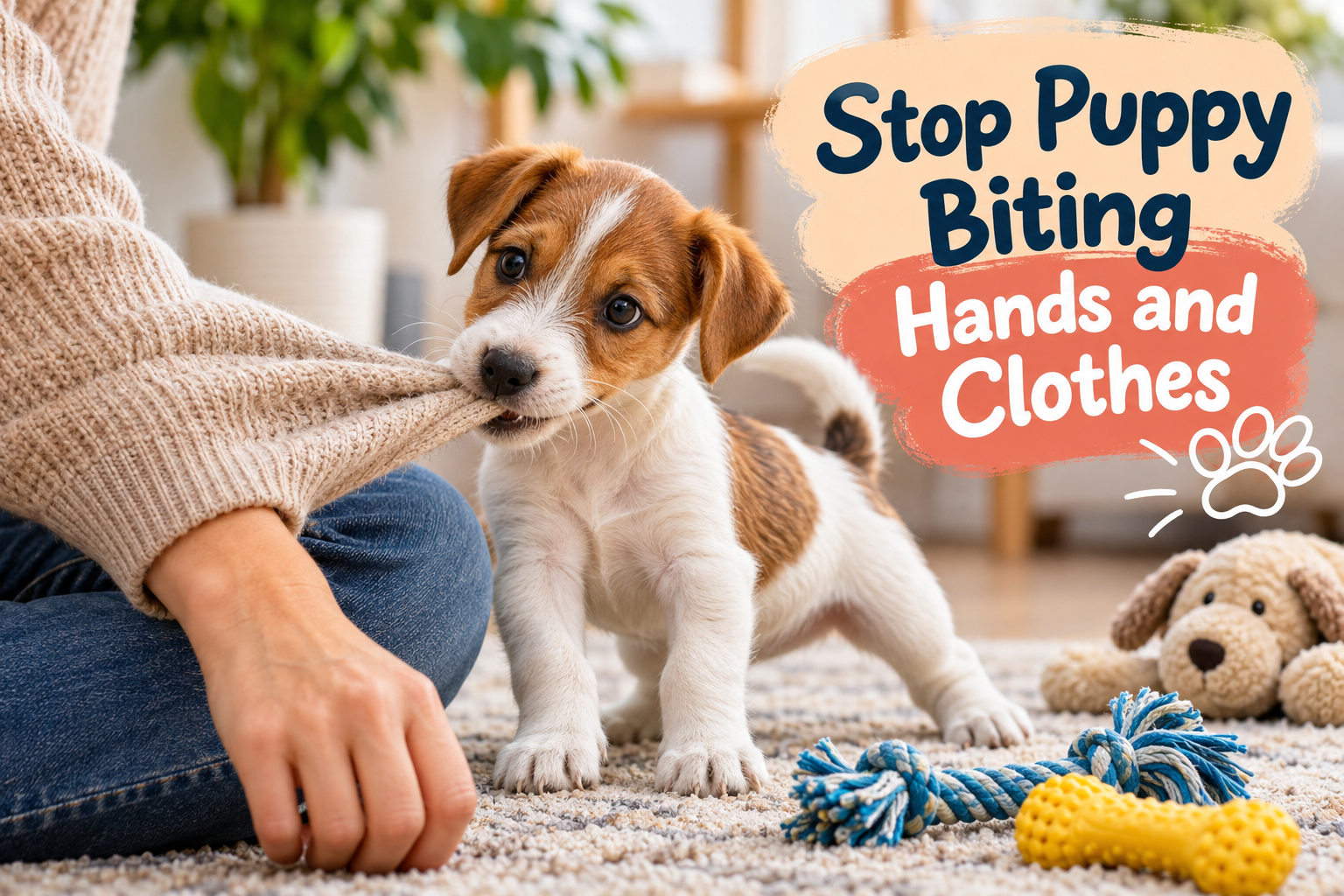
How to Stop Puppy Biting Hands and Clothes (Without Yelling or Punishment)
Your puppy grabs your fingers, pulls at your sleeves, and suddenly decides your favorite pants are the perfect chew toy. Sound familiar?
One minute, you’re enjoying a lovely moment with your new puppy. The next, those tiny, sharp teeth are attached to your hand.
You try to pull away, but your puppy gets even more excited. You say “No!” and somehow that makes the game even more interesting.
If this happens in your home, you’re certainly not alone.
Puppy biting is normal, but that doesn’t mean you have to accept painful bites or ruined clothes.
The good news? You can teach your puppy to interact with people more gently without shouting, frightening, or punishing them.
Let’s look at why puppies bite, what actually helps, and how to make everyday life a little more peaceful.
Why Does My Puppy Keep Biting My Hands and Clothes?
Before trying to stop the biting, it helps to understand what’s causing it.
Puppies don’t explore the world the same way we do. They use their mouths to investigate objects, play, and interact with their surroundings.
Here are some of the most common reasons.
1. Your Puppy Is Learning Through Play
When puppies play with their littermates, they chase, wrestle, and gently bite each other.
If one puppy bites too hard, the other may stop playing or move away.
These early interactions help puppies learn to control the pressure of their bites.
When your puppy comes home, your hands, sleeves, and pant legs may become part of that same playful behavior.
The problem is that human skin is much more sensitive than puppy fur.
2. Teething Makes Chewing More Appealing
Puppies begin developing their baby teeth very early, and most start losing them around three to four months of age.
As their adult teeth come in, chewing may become especially appealing.
You might notice your puppy chewing furniture, grabbing toys, or biting your fingers more frequently.
Appropriate chew toys can help provide an outlet for this natural behavior.
3. Moving Hands and Clothes Look Like Toys
Imagine walking through your living room with a playful puppy following you.
Your pant legs move. Your shoelaces bounce. Your sleeves swing when you reach down.
To an excited puppy, all that movement can look like an invitation to chase and grab.
Pulling your clothes away quickly can make the game even more exciting.
This is why some puppies seem particularly interested in biting ankles and pant legs when their owners walk.
4. Your Puppy Is Overtired or Overexcited
This is something many new puppy owners overlook.
A puppy who has been playing for too long may become increasingly mouthy, restless, and difficult to redirect.
Instead of settling down, they start biting everything around them.
It can look like a sudden burst of energy, but sometimes the puppy simply needs a quiet break.
If your puppy becomes especially bitey in the evening, read our guide on How to Calm a Puppy During the Evening Witching Hour.
How to Stop Puppy Biting Hands: 7 Gentle Steps That Work
You don’t need to frighten your puppy to teach better behavior.
What you do need is consistency, patience, and a clear way to show your puppy what they should bite instead.
Step 1: Stop Using Your Hands as Toys
This is one of the simplest changes you can make.
Avoid encouraging your puppy to chase your fingers, wrestle with your hands, or nibble your knuckles during play.
Even if those little bites seem harmless today, the habit can become painful as your puppy grows.
Instead, use an appropriate toy whenever you want to play.
For example:
- A soft puppy tug toy
- A small, lightweight plush toy
- A puppy-safe rubber chew toy
- A longer toy that keeps teeth away from your fingers
My tip: For small puppies, choose toys that are comfortable for their little mouths but large enough that they cannot swallow them.
Supervise play and remove damaged toys or loose pieces.
Step 2: Redirect Biting to an Appropriate Toy
When your puppy starts reaching for your hands, calmly offer a toy.
Make the toy interesting by moving it gently along the floor.
As soon as your puppy chooses the toy instead of your skin, praise them and continue playing.
You’re teaching a simple lesson:
Hands are not for biting. Toys are for biting.
Keep a few toys within reach in the rooms where your puppy spends the most time.
That way, you won’t have to search for something appropriate while your puppy is already hanging from your sleeve.
If your puppy is too excited to notice the toy, don’t keep pushing it toward their mouth. Give them a short opportunity to settle first.
Step 3: Make Biting End the Fun
Suppose you’re playing with your puppy and those sharp teeth suddenly touch your skin.
Instead of shouting or jerking your hand away, calmly stop the interaction.
Keep your movements slow.
If possible, gently disengage and pause the game for a few seconds.
When your puppy is calm, offer another opportunity to play with a toy.
If biting starts again, repeat the process.
For persistent biting, you can briefly step behind a puppy gate or another safe barrier.
The goal isn’t to scare or isolate your puppy.
It’s to help them learn that biting people makes the exciting interaction stop.
Important: Avoid using a crate as punishment. Your puppy’s crate or resting area should remain a safe, comfortable place.
Step 4: Reward Gentle Behavior
Many owners focus so much on stopping unwanted behavior that they forget to reward the good moments.
But those moments are where learning happens.
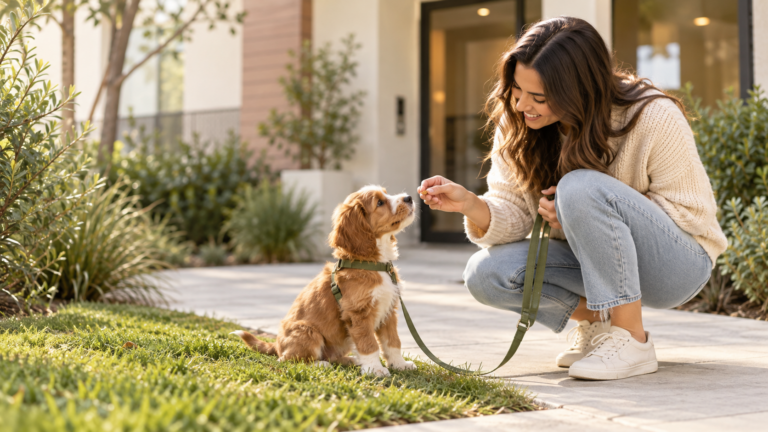
When your puppy approaches without biting, plays with a toy, or calmly sits beside you, give gentle praise or an appropriate reward.
You can use a small treat, a toy, or affection if your puppy enjoys it.
Not every dog finds food equally motivating.
Over the years, I’ve learned that understanding what an individual dog enjoys is just as important as teaching the behavior itself.
Some dogs are delighted by a tiny treat. Others respond beautifully to a favorite toy, gentle attention, or a few happy words.
The important thing is to make the behavior you want worth repeating.
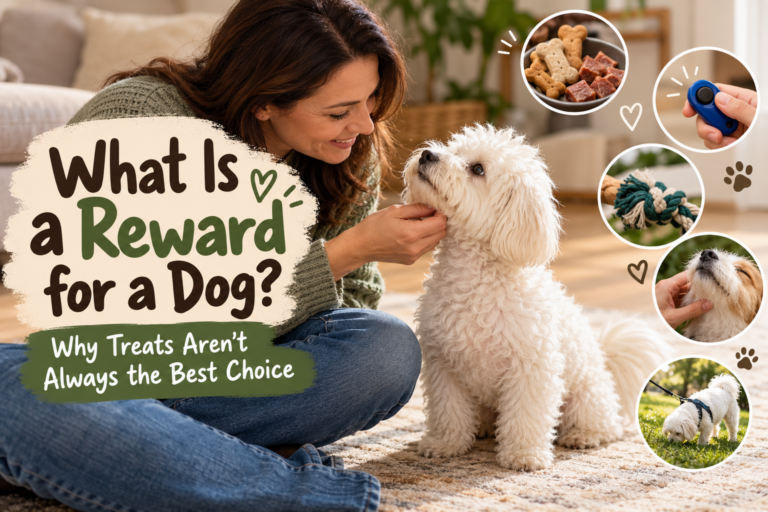
Not sure what motivates your puppy? Read our guide on What Is a Reward for a Dog? to discover why treats aren’t always the best reward.
Step 5: Watch for Signs Your Puppy Needs Rest
If your puppy suddenly starts biting harder, jumping at your clothes, and ignoring familiar cues, ask yourself:
Has my puppy had enough rest today?
Young puppies need plenty of sleep and quiet time.
Create a comfortable resting space away from household noise.
Keep play sessions short and allow regular breaks.
You don’t need to wait until your puppy becomes completely overstimulated.
A predictable routine with play, meals, toilet breaks, and rest can make a big difference.
A consistent potty routine is another important part of your puppy’s day. Our Puppy Potty Training Schedule by Age can help you plan regular bathroom breaks as your puppy grows.
Step 6: Teach Calm Play Before Excitement Takes Over
Try beginning play when your puppy is relaxed rather than already racing around the room.
Use a toy and keep the first sessions short.
If your puppy plays appropriately, praise them.
If excitement increases and biting begins, pause the game.
If your puppy also seems to ignore familiar commands when excited, our guide Why Your Dog Ignores You explains what may be happening and how to respond.
Over time, your puppy can learn that calm, appropriate play keeps the fun going.
Remember that progress isn’t always perfectly consistent.
A puppy may play gently in the morning and become much more mouthy later in the day.
That doesn’t mean the training has failed.
Step 7: Make Sure Everyone Follows the Same Rules
Consistency matters.
If one family member encourages hand wrestling while another tries to stop biting, your puppy receives mixed messages.
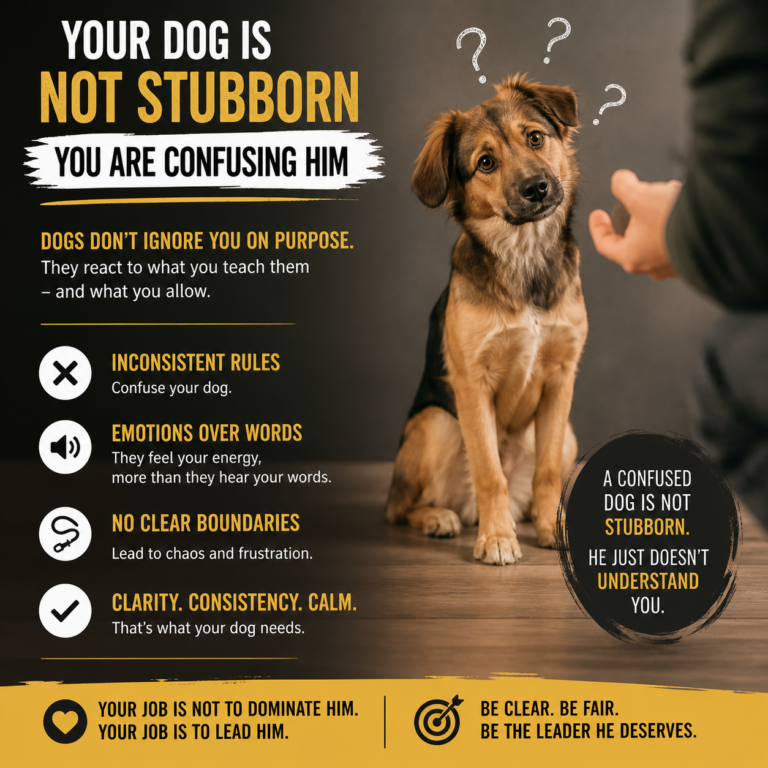
Sometimes, what looks like stubborn behavior is simply confusion. Learn more in our article Your Dog Is Not Stubborn – You Are Confusing Him.
Agree on a few simple household rules:
- Hands and clothing are never used as chew toys.
- Everyone redirects biting toward appropriate toys.
- Play stops calmly when teeth touch skin.
- Gentle behavior gets attention and rewards.
- Nobody hits, shouts at, or deliberately frightens the puppy.
Children should always be supervised around puppies.
Adults should manage biting situations rather than expecting young children to handle them independently.
How to Stop a Puppy From Biting Clothes and Pant Legs
Clothing biting deserves special attention because it often happens when you’re moving.
You may notice your puppy grabbing your trousers when you walk toward the kitchen or attacking your sleeves when you bend down.
Here’s what to do.
When Your Puppy Grabs Your Pant Legs
First, stop walking if it’s safe to do so.
Avoid kicking your leg, shaking your foot, or trying to pull your trousers away.
Those movements can encourage chasing and tugging.
Wait for a moment when your puppy loosens their grip, then calmly redirect them to an appropriate toy or scatter a few suitable treats on the floor to interrupt the interaction.
Once your puppy is engaged elsewhere, move away.
If this happens frequently, try offering a toy before you begin walking through an area where biting usually starts.
Prevention is often easier than interrupting an excited puppy.
When Your Puppy Bites Your Sleeves
Loose sleeves can be especially tempting.
If your puppy grabs your sleeve, avoid turning it into a tug-of-war.
Keep your arm as still as practical and calmly encourage your puppy to release the fabric.
Offer a toy or use a reward to redirect their attention.
If the puppy repeatedly grabs clothing, choose less tempting clothes during training sessions and use a gate or playpen to manage the environment.
Never pull fabric forcefully from a puppy’s mouth, especially if it could damage their teeth or cause them to swallow a piece.
When Your Puppy Bites Your Feet or Ankles
This often happens during movement.
Try rewarding your puppy for walking beside you without grabbing your feet.
Begin with just one or two steps in a quiet area.
Reward calm movement before biting starts.
Gradually increase the number of steps as your puppy succeeds.
If your puppy becomes too excited, make the exercise easier or take a break.
A Simple 7-Day Puppy Biting Training Plan
This plan won’t magically eliminate biting in one week. It’s a gentle way to begin building better habits.
| Day | What to Practice |
|---|---|
| Day 1 | Notice when and where biting happens most often. |
| Day 2 | Replace hand play with appropriate puppy toys. |
| Day 3 | Practice calmly pausing play when teeth touch skin. |
| Day 4 | Reward gentle interactions throughout the day. |
| Day 5 | Practice walking without grabbing pant legs. |
| Day 6 | Review your puppy’s rest periods and daily routine. |
| Day 7 | Combine the exercises and identify what works best. |
Keep practice sessions short and positive.
If your puppy struggles with an exercise, return to an easier version.
Some puppies improve quickly, while others need several weeks or longer to develop reliable habits.
The aim is steady progress, not perfection.
5 Common Mistakes That Can Make Puppy Biting Worse
Even loving owners sometimes react in ways that accidentally encourage biting.
Here are five mistakes worth avoiding.
1. Pulling your hands away dramatically
Fast movement can trigger another playful chase.
2. Shouting or repeatedly saying “No!”
Some puppies become more excited by loud reactions. Others may become frightened.
Neither response teaches them what to do instead.
3. Allowing hand biting sometimes but not others
Inconsistent rules make learning harder.
4. Playing until your puppy becomes exhausted and overstimulated
Short, enjoyable sessions with rest breaks are often more productive.
5. Punishing your puppy physically
Never hit, hold your puppy’s mouth shut, force them onto their back, or use painful corrections.
These methods can cause fear, damage trust, and potentially make behavior problems worse.
Gentle training doesn’t mean allowing your puppy to do whatever they want.
It means setting clear boundaries while helping them learn safely.
What Is Normal Puppy Biting, and When Should You Be Concerned?
Most playful puppy mouthing is part of normal development.
However, not every biting situation should be treated as ordinary puppy play.
| Usually normal puppy behavior | Signs that need closer attention |
|---|---|
| Mouthing during play | Repeated bites that puncture skin |
| Grabbing toys or moving clothes | Biting associated with fear or guarding |
| Increased chewing during teething | Sudden biting when touched or handled |
| Becoming mouthy when overexcited | Stiff posture, freezing, or threatening behavior |
| Gradually improving with training | Biting that escalates or causes significant injury |
These signs aren’t a diagnosis. Context matters, and some playful puppies can also bite hard enough to injure someone.
If biting is severe, escalating, or accompanied by signs of fear, pain, or aggression, seek help from a veterinarian and a qualified reward-based behavior professional.
Sudden changes in behavior or sensitivity to touch should be discussed with your veterinarian to rule out pain or another medical problem.
If a bite breaks the skin, clean the wound and seek appropriate medical advice, especially for deep punctures, bites to the hand or face, or bites involving children.
When Do Puppies Stop Biting So Much?
Many puppies become noticeably less mouthy as they mature, develop better self-control, and complete teething.
Most dogs have their adult teeth by around six to seven months of age, although the timing varies.
But there’s an important distinction:
Finishing teething doesn’t automatically mean your puppy has learned not to bite people.
Training, appropriate play, rest, and consistent boundaries still matter.
Some puppies improve earlier. Others remain mouthy through adolescence.
Rather than focusing only on age, look for small improvements:
- Your puppy chooses toys more often.
- Biting happens less frequently.
- Play is easier to interrupt.
- Your puppy settles more easily.
- Your clothes survive more play sessions!
Those are meaningful signs of progress.
Frequently Asked Questions
It’s better to encourage your puppy to play with toys instead of making hands part of the game.
This creates a clearer, more consistent rule and helps prevent painful biting as your puppy grows.
Some puppies may pause when they hear a yelp, but others become more excited and bite again.
If vocal reactions increase your puppy’s excitement, calmly stopping the interaction is a better option.
Your puppy may associate you with exciting play, moving clothing, or particular routines.
It doesn’t necessarily mean they dislike you or are trying to dominate you.
Observe what happens immediately before biting to identify patterns.
Evening biting can be related to accumulated excitement, fatigue, or an overstimulating daily routine.
Try calmer activities, shorter play sessions, and a predictable rest schedule.
Yes. Appropriate puppy chew toys can provide a safe outlet for chewing.
Choose toys suitable for your puppy’s size and chewing style. Avoid objects that are so hard they could damage teeth, and supervise chewing.
There’s no fixed timeline.
Some puppies respond to consistent training within a few weeks, while others need longer.
Age, temperament, environment, and daily routines all influence progress.
Final Thoughts: Your Puppy Isn’t Trying to Be Bad
When your puppy grabs your fingers for the tenth time in one morning, it’s easy to feel frustrated.
But remember that your puppy is still learning how to live in a human world.
They don’t automatically understand why biting another puppy during play is different from biting your hand.
That’s something we need to teach them.
Be patient, stay consistent, and celebrate the small improvements.
Offer appropriate toys, reward gentle behavior, and make sure your puppy gets enough rest.
Most importantly, don’t turn training into a battle.
A puppy who learns through trust and positive experiences is building habits that can last a lifetime.
And one day, those tiny sharp teeth that used to chase your sleeves will be nothing more than a funny memory.
Author’s note: This article provides general puppy training information and is not a substitute for individualized veterinary or behavioral advice. If biting is severe, escalating, or associated with fear or pain, consult your veterinarian and a qualified reward-based behavior professional.